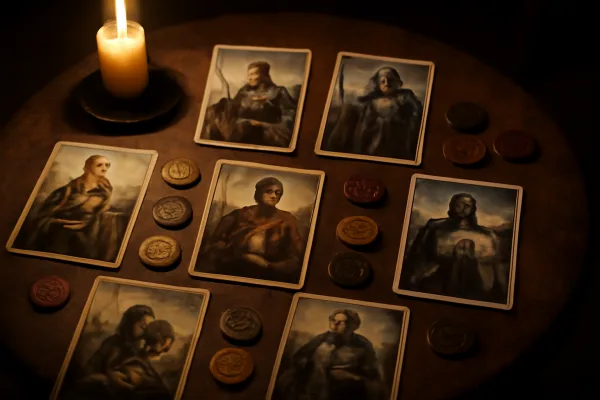
The Resistance: Avalon is one of the most elegant social deduction games ever designed. In a genre that sometimes overcomplicates itself with sprawling rule sets and dozens of special roles, Avalon strips the experience down to its essential core: a small group of players, hidden loyalties, and the impossible challenge of determining who among your friends is secretly working against you. With games lasting just 30 minutes, no player elimination, no moderator required, and a price point under twenty dollars, Avalon has earned its place as one of the most recommended social deduction games for groups of 5 to 10 players.
Originally designed by Don Eskridge and published by Indie Boards and Cards, The Resistance: Avalon builds on the original game The Resistance (2009) by adding Arthurian theme characters that provide hidden information and create deeper strategic possibilities. Since its release in 2012, Avalon has maintained a consistently high rating on BoardGameGeek, where it sits among the top-rated party games with an average score of 7.6 out of 10 based on over 60,000 ratings.
This guide covers everything you need to know about Avalon: the complete rules explained clearly, the function of each special character, winning strategies for both the good and evil teams, common mistakes to avoid, and how Avalon compares to other social deduction games you might be considering.
How Avalon Works: Complete Rules Explained
Avalon is a game of hidden loyalties for 5 to 10 players. At the beginning of the game, each player receives a loyalty card that assigns them to either the Loyal Servants of Arthur (good team) or the Minions of Mordred (evil team). The good team always outnumbers the evil team, but the evil players know each other’s identities while the good players operate in the dark.
The game plays out over up to 5 rounds called “Quests.” Each round follows this structure:
- Team proposal: The current Leader proposes a team of players to go on the Quest. The required team size varies by round and player count.
- Team vote: ALL players simultaneously vote to approve or reject the proposed team using Approve/Reject tokens. If a majority approves, the team goes on the Quest. If the majority rejects, the Leader token passes to the next player and a new team is proposed. Five consecutive rejections result in an automatic evil team victory.
- Quest resolution: The approved team members secretly submit Success or Fail cards. Good players MUST submit Success. Evil players can submit either Success or Fail. If even one Fail card is submitted, the Quest fails (evil team scores). If all cards are Success, the Quest succeeds (good team scores).
The first team to win 3 Quests wins the game, with one critical exception: if the good team wins 3 Quests, the evil team gets one final chance. If the evil team can correctly identify which good player has the Merlin role, the evil team wins instead. This “Assassination” phase adds a dramatic final act that keeps the evil team invested even when they appear to be losing.
| Players | Good Team | Evil Team | Quest 1 Size | Quest 2 Size | Quest 3 Size | Quest 4 Size | Quest 5 Size |
|---|---|---|---|---|---|---|---|
| 5 | 3 | 2 | 2 | 3 | 2 | 3 | 3 |
| 6 | 4 | 2 | 2 | 3 | 4 | 3 | 4 |
| 7 | 4 | 3 | 2 | 3 | 3 | 4* | 4 |
| 8 | 5 | 3 | 3 | 4 | 4 | 5* | 5 |
| 9 | 6 | 3 | 3 | 4 | 4 | 5* | 5 |
| 10 | 6 | 4 | 3 | 4 | 4 | 5* | 5 |
*In games with 7 or more players, Quest 4 requires two Fail cards to fail instead of one. This rule prevents the evil team from winning too easily in larger games.
Special Characters: The Heart of Avalon
What elevates Avalon above the original Resistance is its cast of special characters that add hidden information and strategic depth. These characters are optional but highly recommended for experienced groups. Here is a breakdown of each character and their strategic role:
Merlin (Good Team): During the setup phase, Merlin opens their eyes and sees which players are on the evil team (except Mordred, if in play). Merlin knows the truth but must communicate it subtly. If Merlin is too obvious about their knowledge, the evil team will identify and assassinate them at the end, stealing a victory from the jaws of defeat. Playing Merlin is one of the most challenging and rewarding experiences in social deduction gaming.
Percival (Good Team): Percival sees which players have the Merlin and Morgana roles but cannot distinguish between them. Percival’s job is to figure out which of the two is the real Merlin and protect them, while also being careful not to reveal Merlin’s identity through their protection. You might also enjoy our guide on Secret Hitler strategy.
Mordred (Evil Team): Mordred is hidden from Merlin’s sight. This means Merlin sees all evil players except Mordred, which introduces a critical gap in Merlin’s otherwise perfect information. Mordred is extremely powerful because they can act aggressively without fear of being identified by Merlin.
Morgana (Evil Team): Morgana appears as Merlin to Percival, creating confusion about who is providing genuine information. Morgana’s goal is to act like Merlin, feeding misleading information to the good team while Percival struggles to determine who the real Merlin is.
Oberon (Evil Team): Oberon is unknown to the other evil players, and Oberon does not know who the other evil players are. This creates a wild card on the evil team who cannot coordinate but also cannot be given away by the other evil players’ behavior. Oberon adds chaos and unpredictability.
“Avalon takes the pure social deduction experience and elevates it with just enough mechanical structure to create consistently great games. It is the game I recommend more than any other to groups of 5 to 10 players who want meaningful social deduction without a long time commitment.” — Quintin Smith, Shut Up and Sit Down
Winning Strategies for the Good Team
The good team faces a fundamental challenge in Avalon: they are the majority, but they operate with less information than the evil team. Here are strategies that experienced good players use to overcome this disadvantage:
Vote patterns reveal everything. The single most valuable source of information in Avalon is how people vote on team proposals. Evil players generally do not want to send an all-good team on a Quest (because it will succeed), so they will typically vote to reject good teams and approve teams that include evil members. By tracking who votes to approve and reject each proposed team, you can identify patterns that reveal hidden loyalties.
Pay attention to Quest 1. Quest 1 is the least strategically important Quest, but it provides the most information. Watch who proposes what team, who votes to approve, and whether the Quest succeeds or fails. A Quest 1 failure immediately tells you that at least one person on that team is evil. A Quest 1 success is less informative but narrows the search space.
Build consensus gradually. The good team wins by building accurate consensus about who is trustworthy. Share your observations openly, propose logical team compositions, and be willing to change your mind when presented with new information. The evil team wins when the good team is divided and confused, so anything that builds shared understanding works in your favor.
Protect Merlin without exposing them. If Merlin is in play, the good team must win 3 Quests AND keep Merlin’s identity hidden from the Assassin. This means good players should be careful about blindly following one person’s recommendations, even if that person seems to have perfect information. If everyone follows one player, the evil team will know that player is Merlin. Spread the influence around.
Winning Strategies for the Evil Team
The evil team has the advantage of perfect information about each other but must overcome being outnumbered. These strategies help evil players maximize their advantage: For additional reading, visit Avalon on BoardGameGeek.
Coordinate your fails strategically. The most common evil team mistake is failing Quests too aggressively, which reveals evil players’ identities. Sometimes it is better to let a Quest succeed (by submitting a Success card even though you could submit Fail) to maintain your cover. Save your Fail cards for critical moments where a Quest failure will be most impactful.
Establish trust early. At least one evil player should focus entirely on building trust with the good team during the first 2 Quests. Submit Success on early Quests, support reasonable team proposals, and behave exactly like a good player would. This invested trust pays dividends later when you use your credibility to steer the good team toward poor decisions.
Create suspicion between good players. Your most powerful weapon is not your own deception — it is the good team’s doubt about each other. If you can convince two good players that the other is evil, they will spend the rest of the game fighting each other instead of finding you. Subtle misdirection during discussions, strategic voting patterns, and carefully timed accusations can create these divisions.
Find and assassinate Merlin. Even if you lose 3 Quests, you can win the game by correctly identifying Merlin. Throughout the game, watch for players who seem to have suspiciously accurate reads on who is evil. Note who avoids accusing specific evil players (Merlin might avoid direct accusations to hide their knowledge). The Assassination attempt is your insurance policy, and a good Assassin can steal victories that seemed lost.
Recommended Character Combinations by Player Count
The character combinations you use dramatically affect the game’s balance and feel. Here are our recommended setups for each player count:
| Players | Good Characters | Evil Characters | Game Feel |
|---|---|---|---|
| 5-6 | Merlin + Percival + Loyalists | Assassin + Morgana | Tight, information-rich, great for learning |
| 7 | Merlin + Percival + Loyalists | Assassin + Morgana + Oberon | Chaotic evil team; good for experienced groups |
| 7 (alt) | Merlin + Percival + Loyalists | Assassin + Mordred + Morgana | Harder for Merlin; more strategic evil play |
| 8-10 | Merlin + Percival + Loyalists | Assassin + Mordred + Morgana (+ Oberon at 10) | Full complexity; best for dedicated groups |
For your first game, use only Merlin and the Assassin (no other special characters). This teaches the core mechanics and the Assassination end-game without overwhelming new players. Add Percival and Morgana for your second game, and Mordred for your third. This gradual introduction ensures everyone understands each character’s impact before adding more complexity.
Avalon vs. Other Social Deduction Games
| Feature | Avalon | Secret Hitler | Werewolf | Blood on the Clocktower |
|---|---|---|---|---|
| Players | 5-10 | 5-10 | 7-30+ | 5-20 |
| Time | 30 min | 30-60 min | 15-60 min | 45-150 min |
| Moderator needed? | No | No | Yes | Yes (Storyteller) |
| Player elimination? | No | Yes (execution power) | Yes (major drawback) | Yes (but ghosts stay engaged) |
| Core mechanic | Mission voting | Policy passing | Night kills + day voting | Storyteller-driven roles |
| Price | $15-20 | $25-35 | $0-20 | $99-130 |
| Best for | Clean, elegant deduction | Political intrigue | Large groups, theater | Deep, immersive sessions |
Avalon’s niche is clean, elegant social deduction with no moderator and no elimination. It lacks the dramatic flair of Werewolf and the strategic depth of Blood on the Clocktower, but it executes its specific design goals better than almost any game in the genre. For groups that want a reliable, quick social deduction experience that consistently delivers great games, Avalon is hard to beat. For more on this topic, check out our article about Coup board game.
Common Mistakes and How to Avoid Them
Even experienced players make predictable errors in Avalon. Being aware of these common mistakes can immediately improve your play:
Approving teams too easily. New good players often approve teams without much thought, sending potentially compromised teams on Quests. Be selective about which teams you approve. Every team vote is information, and rejecting a suspicious team proposal is often more valuable than approving a questionable one.
Failing to track votes. Many players focus exclusively on what people say during discussions and ignore how they vote. Voting patterns are the most reliable data point in Avalon because they require commitment (you cannot take back a vote), unlike verbal statements which can be cheap talk. Use a notepad or phone to track every vote throughout the game.
Playing Merlin too obviously. New Merlin players often cannot resist the urge to share their knowledge directly, making statements like “I am absolutely certain Player X is evil.” This is a death sentence for Merlin. Good Merlin play involves subtly steering the conversation toward correct conclusions without making it obvious that you have insider knowledge. Frame your suspicions as logical deductions rather than certainties.
Evil players failing every Quest they are on. New evil players often feel compelled to submit a Fail card every time they are on a Quest team. This quickly reveals their identity because the good team can narrow down the evil players by process of elimination. Strategic evil play sometimes requires submitting Success cards to maintain your cover for a more critical moment later in the game.
Conclusion
The Resistance: Avalon is a masterpiece of social deduction design that deserves a place in every game collection. Its combination of elegant mechanics, meaningful choices, zero downtime, and dramatic end-game Assassination creates an experience that is consistently excellent across hundreds of plays. At under twenty dollars and with games lasting just 30 minutes, Avalon offers perhaps the best value proposition in the entire social deduction genre.
Whether you are building your first social deduction collection or looking for a reliable game to fill the gap between longer sessions, Avalon delivers the core promise of the genre: a group of friends, hidden loyalties, and the electric thrill of discovering who has been working against you all along. Learn more at The Resistance.
Found this helpful? Share it with your game night crew.
Frequently Asked Questions
What is the difference between The Resistance and Avalon?
The core gameplay is identical. Avalon adds the Arthurian theme and special characters (Merlin, Percival, Mordred, Morgana, Oberon) that provide hidden information and deepen the strategic experience. Most experienced players prefer Avalon because the special characters add significant depth without much additional complexity.
Can you play Avalon with just 4 players?
The official minimum is 5 players. With 4, the balance between good and evil breaks down, and there is not enough information to create meaningful deduction. If you have only 4 players, consider Coup or One Night Ultimate Werewolf as alternatives that work better at lower counts.
Is Avalon good for families with teenagers?
Absolutely. Avalon has no mature content and is suitable for ages 13 and up. The Arthurian theme is family-friendly, and the game’s strategic depth keeps teenagers engaged without overwhelming younger players. Start without special characters for the first game to keep things simple.
How many times can you play Avalon before it gets repetitive?
Avalon has exceptional replayability because the social dynamics change with every game. Even with the same group and the same character setup, different role assignments create entirely different games. Most dedicated groups play Avalon hundreds of times without experiencing significant repetition. Adding or changing special characters introduces fresh dynamics whenever the game starts to feel familiar.
Is Avalon better than Secret Hitler?
Both are excellent games that serve different preferences. Avalon is cleaner, faster, and more focused on pure deduction. Secret Hitler adds a policy-passing mechanic that creates additional ambiguity and strategic layers. If your group values elegant simplicity, choose Avalon. If your group enjoys more complex strategic decisions and does not mind slightly longer games, choose Secret Hitler. Many groups own and enjoy both.
Advanced Avalon: The Meta-Game
After dozens of games with the same group, Avalon develops a rich meta-game layer that transcends the mechanics printed in the rulebook. This meta-game is what keeps veteran players coming back for hundreds or even thousands of sessions, and understanding it is what separates good players from great ones. We also have a great resource on murder mystery themes that you might find helpful.
Reputation management across sessions: In a regular Avalon group, your behavior in previous games affects how people perceive you in the current game. If you played Merlin brilliantly last session and were never identified, players will be watching you more carefully this time. If you pulled off a spectacular betrayal as a Minion, people may be more suspicious of you even when you are genuinely good. Great players learn to manage their cross-session reputation, sometimes deliberately playing against their established patterns to remain unpredictable.
Reading physical tells: Over many games, you will learn each player’s unconscious physical behaviors when they are lying versus telling the truth. Some people make less eye contact when deceiving. Some become unnaturally still. Some overcompensate with excessive friendliness. These physical tells are unreliable in isolation but become increasingly valuable as you accumulate observations across dozens of games. The best Avalon players maintain a mental database of each regular player’s behavioral patterns.
The theory of mind ladder: Advanced Avalon involves recursive reasoning about what other players think you are thinking. Level 0: What do I know? Level 1: What do they think I know? Level 2: What do they think I think they know? Level 3: What do they think I think they think I know? The best plays in Avalon often involve climbing this ladder higher than your opponents, making moves that only make sense when analyzed at the right level of recursive reasoning.
Developing group-specific conventions: Regular groups naturally develop unspoken conventions about how the game is played. These might include specific voting patterns that signal trustworthiness, discussion norms that shape information sharing, or strategic approaches that have become standard within the group. Understanding and occasionally subverting these conventions is a key part of advanced play.
The importance of fun: Perhaps the most important meta-game insight is that Avalon is ultimately about shared enjoyment. The most successful Avalon groups are those that celebrate clever plays regardless of which team benefits, that laugh at spectacular failures and brilliant deceptions equally, and that maintain friendships above competition. The game is at its best when every player, win or lose, walks away from the table smiling and eager for the next round. Keep this perspective, and your Avalon games will be memorable for years to come.
Where to Buy and What is in the Box
The Resistance: Avalon is widely available through multiple channels:
- Amazon: Typically priced at fifteen to twenty dollars for the standard edition. Check for the version published by Indie Boards and Cards to ensure you are getting the official product.
- Local game stores: Most independent board game stores carry Avalon. Buying local supports your community’s gaming ecosystem and often comes with the added benefit of knowledgeable staff who can answer questions about the game.
- Board Game Arena (online): A free digital implementation is available on Board Game Arena (boardgamearena.com), which allows you to play online with friends or strangers. This is an excellent way to learn the game before purchasing the physical version.
- Target and Walmart: Both major retailers occasionally carry Avalon in their board game sections, often at competitive prices.
The box includes: character cards for all roles, loyalty cards for good and evil, team tokens, vote tokens (approve and reject), Quest cards (success and fail), a Leader token, a Round marker, the Lady of the Lake token (an advanced variant), and a comprehensive rulebook. Everything you need to play is included, and the components are durable enough to withstand hundreds of games. The small box size makes Avalon an excellent travel game that fits easily in a backpack or carry-on bag.