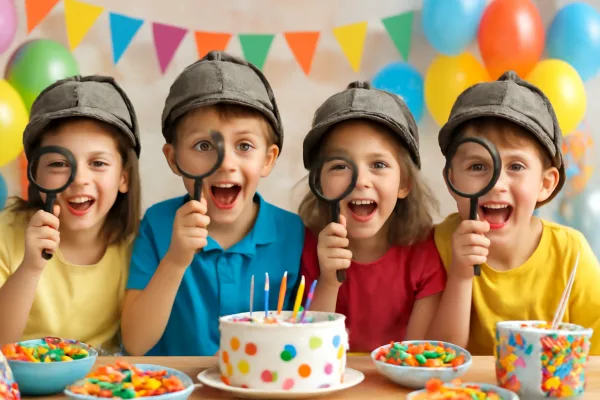
Murder mystery parties are not just for adults. With the right script, theme, and age-appropriate modifications, kids and teenagers can have an absolute blast solving a mystery with their friends. In fact, mystery-themed parties are consistently rated among the top birthday party formats by parents on platforms like What Moms Love and Today’s Parent, with 92% of parents reporting that their children talked about the party for weeks afterward. The combination of costumes, teamwork, problem-solving, and dramatic reveals creates an experience that stands out from the typical bowling-or-pizza birthday formula.
Planning a murder mystery party for younger guests requires different considerations than an adult event. The mystery itself should not involve actual “murder” for younger children. Instead, use age-appropriate crimes like stolen jewels, missing artifacts, or vanished pets. The clue structure should be simpler and more guided. And the pacing should be faster, because children’s attention spans are shorter than adults’.
This guide covers how to plan and execute mystery parties for three age groups: kids (ages 7 to 11), tweens (ages 11 to 13), and teenagers (ages 13 to 17). Each section includes theme recommendations, script sources, activity ideas, food suggestions, and tips for managing the unique social dynamics of each age group.
Mystery Parties for Kids (Ages 7-11): The Detective Adventure
For younger children, mystery parties work best as guided adventures where the host leads the group through a series of clue stations. Rather than a traditional murder mystery with character roles and accusations, think of it as a scavenger hunt with a narrative framework. The children are all detectives working together to solve a crime that does not involve violence.
Best themes for kids:
| Theme | Mystery Premise | Costume Ideas | Difficulty |
|---|---|---|---|
| Spy Academy | Solve the coded message to find the stolen secret formula | Dark clothes, sunglasses, toy walkie-talkies | Easy |
| Detective Agency | Find the missing neighborhood pet using witness clues | Magnifying glasses, notebooks, detective hats | Easy |
| Pirate Treasure | Follow the treasure map and solve riddles to find the gold | Pirate hats, eye patches, bandanas | Easy |
| Museum Heist | Discover who stole the priceless painting from the museum | Fancy clothes or “burglar” black outfits | Medium |
| Fairy Tale Mystery | Figure out which fairy tale character ate the magic cookies | Favorite fairy tale character | Easy |
Activity structure for kids (90 minutes total):
- 0-15 min: Arrival, costume distribution (provide detective kits: magnifying glass, notebook, pencil, badge), and briefing from the host (“Detectives, we have a case!”)
- 15-45 min: Clue stations (4 to 5 stations around the house or yard, each with a puzzle that yields a piece of the solution). Activities include: decoding a simple cipher, matching fingerprints, interviewing a “witness” (an adult playing a character), assembling a torn clue, finding hidden objects
- 45-60 min: Solution assembly and reveal. The group works together to combine their clues and identify the culprit. Celebrate with cheers and detective certificates.
- 60-90 min: Food, cake, and free play. Themed snacks and the birthday cake close out the party.
Pro tips for kid mystery parties:
- Keep puzzles collaborative, not competitive. Children this age work best when everyone succeeds together.
- Have an adult at each clue station to provide hints and keep the group on track.
- Print detective certificates for every child that say “Official Detective — Case Solved!” Kids love taking home a physical memento.
- Test every puzzle with one child before the party to ensure age-appropriateness. If your test child cannot solve it in 3 minutes with a hint, simplify it.
Mystery Parties for Tweens (Ages 11-13): The Character Mystery
Tweens are ready for the next level: character-based mysteries where each guest plays a specific role with their own secrets, clues, and objectives. This age group thrives on the social element of role-playing and is old enough to manage individual character information independently while still benefiting from structured host guidance.
Best themes for tweens:
- Haunted Sleepover: A ghost is haunting the slumber party, and the guests must figure out which “ghost” is responsible for the mysterious events. (Works perfectly as an actual sleepover activity.)
- Pop Star Mystery: A pop star’s award has been stolen at the concert after-party. Each guest plays a different celebrity or industry character.
- School Whodunit: A school mascot has been “kidnapped” and students must investigate teachers, coaches, and fellow students to find the culprit.
- Camp Mystery: Something strange is happening at summer camp. Each camper character has a secret that connects to the central mystery.
Activity structure for tweens (2 hours): You might also enjoy our guide on themed mystery party ideas.
- 0-20 min: Arrival, character packet distribution, costume time. Give each guest a sealed envelope with their character name, backstory, costume suggestions, and Round 1 information.
- 20-50 min: Round 1 — Introduction and first clue reveal. Host reads the setup, each character introduces themselves, and the first round of clues is distributed.
- 50-80 min: Round 2 and 3 — Investigation rounds with more clue reveals. Encourage guests to question each other, share (or withhold) information, and form theories.
- 80-100 min: Accusation and reveal. Guests make their accusations, vote on the culprit, and the host reveals the solution.
- 100-120 min: Food, awards, and socializing. Award prizes for best detective, best costume, and best character performance.
Script sources for tweens:
- My Mystery Party has a dedicated “teen” category with 30+ age-appropriate mysteries
- Night of Mystery offers “tween-friendly” versions of their most popular scripts
- Free options: search “tween mystery party script” on Teachers Pay Teachers for classroom-tested mysteries that adapt well to parties
Mystery Parties for Teenagers (Ages 13-17): The Full Experience
Teenagers are ready for the complete murder mystery party experience with complex character relationships, multiple rounds of clue reveals, and mysteries that genuinely challenge their deductive skills. This age group responds well to themes that feel sophisticated and “grown-up” without including content that is inappropriate for their age.
Best themes for teenagers:
| Theme | Why Teens Love It | Content Notes |
|---|---|---|
| Celebrity Award Show | Glamorous, social media-friendly costumes and photo ops | No mature content; focus on fame and competition drama |
| Escape Room Mystery | Combines puzzle-solving with mystery investigation | Fully age-appropriate; physical and mental challenges |
| Social Media Influencer | Relatable premise involving online drama and viral scandals | Avoid cyberbullying themes; focus on mystery and comedy |
| Hogwarts Mystery | Harry Potter theme with magical elements and house rivalries | Universally popular; fan-created scripts available free online |
| 1980s Retro | Stranger Things-influenced nostalgia; fun costumes | No mature content; sci-fi or mystery elements work well |
| Classic Whodunit | Clue-inspired mansion mystery with traditional detective elements | The classic format remains popular with mystery-loving teens |
Teenagers can handle the same mystery formats as adults, with two important modifications: avoid themes that involve romantic or sexual content between characters (common in adult mystery kits), and ensure that the “murder” element is handled with the same theatrical detachment found in games like Clue rather than with graphic descriptions. Most commercial mystery kit providers clearly label their age-appropriate options.
Activity structure for teenagers (2.5 to 3 hours):
Follow the same structure as an adult murder mystery party: arrival with character packets, 3 to 4 rounds of clue reveals with discussion time between rounds, an accusation and voting phase, and a reveal followed by socializing. Teenagers tend to be more naturally theatrical than adults and often deliver more committed character performances, making the role-playing element particularly entertaining for this age group.
“The best mystery party I ever attended was when I was 14. My friend’s mom organized a Hogwarts mystery and everyone dressed as their house characters. We talked about it for months. I still remember who the ‘murderer’ was — it was the Slytherin prefect.” — Reddit user on r/MurderMysteryParty
Food Ideas for Each Age Group
| Age Group | Food Style | Specific Ideas | Tips |
|---|---|---|---|
| Kids (7-11) | Fun, simple, themed | “Clue cookies” (magnifying glass shapes), “mystery juice boxes” with custom labels, “evidence bag” chip portions (Ziploc bags labeled “EVIDENCE”) | Keep it simple; themed presentation matters more than fancy food |
| Tweens (11-13) | Upgraded snacks | Pizza with character-named slices, themed cupcakes, “spy gadget” pretzel sticks with cheese dip, themed mocktails in fancy cups | Tweens appreciate food that feels “grown up” without actually being adult food |
| Teens (13-17) | Semi-sophisticated | Build-your-own taco bar, themed appetizers, mocktail bar with garnishes, Instagram-worthy desserts | Teens will photograph everything; invest in visual presentation |
Managing Group Dynamics by Age
Each age group presents unique social dynamics that affect how the mystery party plays out. Understanding these dynamics helps you plan an event that works with the group’s natural tendencies rather than against them.
Kids (7-11): The inclusion challenge. Young children are sensitive to feeling left out or confused. Ensure every child has an equal role and equal access to clues. Avoid competitive elements where some children “win” and others “lose.” Frame the mystery as a team effort where everyone contributes. Pair shy children with outgoing ones. Have an adult ready to redirect any child who becomes frustrated or disengaged.
Tweens (11-13): The social hierarchy challenge. Tweens are acutely aware of social dynamics and may resist playing a character they perceive as “uncool” or may dominate the investigation at the expense of quieter friends. Assign character roles strategically: give leadership roles to quieter children to encourage participation, and give supporting roles to dominant children to practice collaboration. Monitor for exclusion and redirect gently. For additional reading, visit the classic Clue movie.
Teens (13-17): The too-cool-for-school challenge. Some teenagers will initially resist engaging with the mystery because they do not want to appear childish or enthusiastic. The solution is to make the experience feel mature and sophisticated: use high-quality materials, create an atmospheric setting, and start with a brief narrative introduction that sets a serious tone. Once the first accusation is made and the drama begins, even the most reluctant teenager typically gets drawn into the experience.
Party Favors and Keepsakes
Mystery-themed party favors create lasting memories and give guests something tangible to remember the event by. Here are ideas scaled by age group and budget:
- Budget option (all ages): Printed “Detective Certificate” with each guest’s name and the mystery they solved. Cost: paper and printer ink.
- Mid-range option (kids): Detective kit bags containing a magnifying glass, small notebook, pencil, and badge. Cost: $3 to $5 per guest from dollar stores.
- Mid-range option (tweens/teens): A mini mystery game (Clue card game, mystery puzzle book, or a single-use escape room kit). Cost: $5 to $10 per guest.
- Premium option (teens): Custom printed photos from the party’s photo station, framed or in a small album. Cost: $3 to $8 per guest depending on printing method.
The photo element deserves special emphasis for teen parties. Teenagers live on social media, and a dedicated photo station with themed props (magnifying glasses, fake mustaches, “WANTED” poster backdrop, crime scene tape) generates content that guests will share online, effectively promoting your hosting reputation and generating excitement for future events.
Adapting Commercial Mystery Kits for Younger Players
Many popular murder mystery kits are designed for adults but can be adapted for younger players with some modification. Here is how to convert an adult mystery kit for each age group:
For kids: Replace “murder” with “stolen item.” Change character names and backstories to remove any adult themes. Simplify the clue structure by removing 1 to 2 rounds and providing more obvious connections between clues and suspects. Add physical activity elements (a treasure hunt component, a puzzle-solving station) to maintain engagement.
For tweens: Keep the basic mystery structure but rename any references to murder as “mysterious disappearance” or “stolen artifact.” Review character descriptions and remove any romantic, violent, or substance-related content. Maintain the round structure but shorten discussion times to 10 to 15 minutes per round.
For teens: Most teen-appropriate commercial kits require minimal modification. Review character descriptions for any explicitly adult content and tone it down if necessary. The mystery structure, clue distribution, and round format can remain unchanged. Teenagers are sophisticated enough to handle complex plots and ambiguous evidence. For more on this topic, check out our article about free scripts.
Conclusion
Mystery parties for kids and teens create experiences that are educational (critical thinking, reading comprehension, collaboration), social (teamwork, communication, performance), and genuinely fun in ways that passive entertainment cannot match. By adapting the mystery party format to each age group’s developmental stage, attention span, and social dynamics, you can create events that rival any birthday party, school event, or weekend gathering.
Start with the format that matches your child’s age group, choose a theme that excites them, and do not worry about perfection. The magic of a mystery party comes from the shared experience of solving a puzzle together, and even an imperfect mystery with enthusiastic participants will create memories that last far longer than the two hours it takes to play.
Found this helpful? Share it with fellow parents and party planners.
Frequently Asked Questions
What is the minimum age for a mystery party?
Children as young as 6 or 7 can enjoy guided detective adventures with simple clue stations. True character-based mystery parties work best starting at age 10 or 11 when children can manage individual character information independently. For younger children, focus on collaborative puzzle-solving rather than individual character play.
How many kids should I invite to a mystery party?
For kids ages 7 to 11, 6 to 10 guests is ideal. For tweens and teens, 8 to 14 works well with most commercial mystery kits. Having too few players limits the mystery’s complexity, while too many can create logistical challenges and leave some guests without meaningful roles.
What if a child does not want to play their assigned character?
Have 1 to 2 backup characters prepared that can be swapped in. Alternatively, let reluctant children play as “assistant detective” without a specific character role — they participate in the investigation without the pressure of character performance. Most children warm up once the mystery gets going.
Are commercial mystery kits worth the cost for kids’ parties?
For a first-time host, commercial kits ($20 to $40) are worth the investment because they include all materials, clear instructions, and tested puzzle sequences. For experienced hosts, free or homemade mysteries can be equally effective. The key factor is the host’s preparation and energy, not the script’s price tag. Learn more at children mystery books on Goodreads.
Can I run a mystery party at a venue other than my home?
Absolutely. Parks, community centers, libraries, and even restaurants can host mystery parties. Outdoor venues work particularly well for treasure hunt-style mysteries for younger children. Ensure you have permission from the venue, adequate space for group activities, and a backup plan for weather if hosting outdoors.
Real Parent Reviews: What Worked and What Did Not
To provide the most practical advice possible, we collected feedback from parents who have hosted mystery parties for different age groups. Their experiences highlight both the rewarding moments and the common pitfalls that first-time hosts should prepare for.
Sarah M., hosted a detective party for her son’s 8th birthday (12 kids): What worked: the detective kit bags were a huge hit. Every child immediately put on their badge and carried their magnifying glass for the entire party. The clue stations kept them moving and engaged. What I would change: I made the puzzles too hard for some of the younger guests (there was a mix of 7 and 9 year olds). Next time I would have easier versions of each puzzle available as backup. Also, 12 kids was too many for one adult to manage at clue stations. Have at least 2 to 3 adult helpers.
David R., hosted a Hogwarts mystery for his daughter’s 13th birthday (10 teens): What worked: the teens absolutely loved dressing as Harry Potter characters and staying in character throughout the evening. The mystery itself was challenging enough to keep them engaged for the full 2.5 hours. The photo station with wands and house scarves generated incredible social media content. What I would change: I underestimated how much food teenagers eat. Double your food estimate for teen events. Also, provide a clear rules explanation at the beginning, because some teens were confused about when they could share their secret information.
Maria L., hosted a spy-themed mystery for her daughter’s 11th birthday (8 tweens): What worked: the spy theme was perfect for this age group. The coded messages and secret missions made the kids feel sophisticated and important. The mocktail bar where they could mix their own spy drinks was the unexpected highlight. What I would change: two of the quieter girls got overshadowed by more outgoing kids during the investigation rounds. Next time I would assign specific investigation tasks to each child so everyone has a defined role and contribution.
These real-world experiences reinforce several key principles: always have backup plans for puzzles that prove too difficult, ensure every child has a meaningful role regardless of personality type, budget more food than you think you need especially for teenagers, and invest in the costume and photo elements that create the most lasting memories.
Seasonal and Holiday Mystery Party Ideas
Mystery parties align naturally with many holidays and seasonal events, providing perfect opportunities for themed celebrations throughout the year: We also have a great resource on DIY escape room that you might find helpful.
Halloween (October): The most natural fit for mystery parties. Haunted house mysteries, ghost investigations, and spooky whodunits combine with existing Halloween energy to create unforgettable events. Costumes are already expected, decorations are readily available, and the atmosphere practically builds itself.
Winter holidays (December-January): A holiday-themed mystery where someone stole the presents, sabotaged the holiday feast, or committed a crime at the winter gala works for any winter celebration. Combine with a gift exchange for a complete holiday party experience.
Valentine’s Day (February): A love-themed mystery (who sent the mysterious valentines? who stole the chocolate?) works wonderfully for mixed-gender tween and teen groups. The romantic theme is age-appropriate and naturally engaging for older children.
Summer (June-August): Outdoor mystery adventures, pirate treasure hunts, and camp mysteries take advantage of warm weather and longer daylight hours. These outdoor formats work perfectly for birthday parties, neighborhood events, and end-of-school celebrations.
Back-to-school (September): A school-themed mystery party serves as a fun icebreaker for new school years, helping children reconnect with friends and meet new classmates through collaborative play. The familiar school setting makes the mystery accessible even to children who have never participated in a mystery event before.
Planning mystery parties around seasonal events gives you a built-in theme, simplifies decoration choices, and creates natural anticipation. Many families establish an annual mystery party tradition tied to a specific holiday, and children look forward to each year’s mystery with the same excitement they bring to the holiday itself.
Whatever season you choose, the key to a successful holiday mystery party is integrating the mystery with the holiday traditions your family already enjoys. A Halloween mystery followed by trick-or-treating. A winter mystery followed by hot cocoa and gift opening. A summer mystery followed by a pool party or barbecue. These combinations create multi-layered events that are greater than the sum of their parts, and they establish the mystery party as a cherished family tradition that children will remember and request year after year.