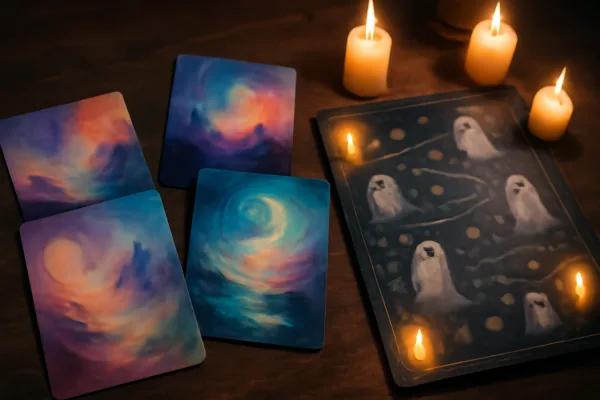
Mysterium occupies a unique space in the board gaming world. It is a cooperative game where one player is a ghost who communicates exclusively through abstract, dreamlike artwork, while the other players are psychic investigators trying to interpret the ghost’s visions to solve a murder. If that premise sounds unusual, that is because it is — and that unusual combination of cooperative deduction, visual interpretation, and atmospheric storytelling has made Mysterium one of the most beloved board games of the past decade, with over 1 million copies sold worldwide since its release in 2015.
Published by Libellud (the same company behind Dixit), Mysterium combines the visual communication mechanics of Dixit with the logical deduction structure of Clue, wrapped in a gorgeous gothic aesthetic that turns every game session into a hauntingly beautiful experience. BoardGameGeek ranks it among the top 100 family games of all time, with an average rating of 7.2 based on over 40,000 reviews. Whether you are a seasoned board gamer looking for something different or a casual player drawn in by the stunning artwork, Mysterium delivers an experience that no other game replicates.
This guide covers everything you need to know about Mysterium: the complete rules, strategies for both the Ghost and Psychic roles, tips for teaching new players, and how the game compares to similar titles in the cooperative deduction space.
How Mysterium Works: Rules for New Players
Mysterium is a cooperative game for 2 to 7 players. One player takes the role of the Ghost, the murdered victim who haunts the manor where the crime took place. The remaining players are Psychics who have been invited to a seance to help the Ghost communicate the circumstances of the murder. The Ghost cannot speak, point, gesture, or make any noise. Their only form of communication is abstract “vision cards” — beautifully illustrated cards depicting surreal, dreamlike imagery.
The game proceeds through two phases:
Phase 1 — Reconstruction (Rounds 1-7): The Ghost must guide each Psychic to discover three things: the correct Suspect, the correct Location, and the correct Object (murder weapon). In each round, the Ghost gives each Psychic one or more vision cards that they believe connect to the Psychic’s assigned suspect, location, or object. The Psychics discuss the visions together and each places their intuition token on the card they believe the Ghost is pointing them toward.
The Psychics must identify all three elements (Suspect, Location, Object) within 7 rounds. If any Psychic fails to complete their trio, the group loses.
Phase 2 — Final Vision: If all Psychics complete Phase 1 successfully, the Ghost presents one final vision to the entire group. Based on their combined understanding of the Ghost’s communication style throughout the game, the Psychics vote on which combination of Suspect-Location-Object they believe is the true culprit. A majority correct vote wins the game for the entire group.
| Component | Quantity | Purpose |
|---|---|---|
| Vision cards | 84 | The Ghost’s only communication tool — abstract artwork that must be interpreted |
| Suspect cards | 18 | Potential murderers with distinct visual characteristics |
| Location cards | 18 | Rooms in the manor where the murder could have occurred |
| Object cards | 18 | Potential murder weapons |
| Ghost screen | 1 | Hides the Ghost’s assigned combinations from the Psychics |
| Clock board | 1 | Tracks the 7 rounds available in Phase 1 |
| Clairvoyance tokens | Various | Used by Psychics to predict whether other Psychics’ guesses are correct |
Playing as the Ghost: Strategy and Tips
The Ghost role is Mysterium’s most challenging and most rewarding position. You cannot speak, cannot gesture, cannot make eye contact that might give away information. Your entire communication toolkit consists of abstract artwork that may or may not bear any resemblance to what you are trying to convey. This constraint is what makes the role brilliantly creative and occasionally maddening.
Think like your Psychics, not like yourself. The most common Ghost mistake is choosing vision cards based on connections that make sense to you but not to your audience. Before placing a vision card, ask yourself: “If I were a Psychic looking at this card without my knowledge, what would I think it refers to?” A card depicting a red rose might seem obviously connected to the Garden location to you, but your Psychics might focus on the color red or the romantic connotation instead. You might also enjoy our guide on detective board games.
Use color and shape before symbolism. In general, direct visual matches (the card shows something blue, the target card is predominantly blue) are more reliably interpreted than symbolic connections (the card shows a crown, symbolizing royalty, connecting to the aristocrat suspect). When you have a choice between a card with a direct visual match and a card with a clever symbolic connection, choose the direct match. Save symbolic communication for situations where no direct visual match is available.
Give multiple vision cards when available. The Ghost can give 1 to 7 vision cards per Psychic per round (distributing from their hand of 7). Multiple cards that point to the same target through different visual elements provide more information and reduce the chance of misinterpretation. However, giving too many cards to one Psychic means having fewer available for other Psychics, so balance is key.
Track what each Psychic focuses on. Different Psychics have different interpretation styles. Some focus on colors, some on objects, some on emotions, and some on patterns. After the first round or two, you will start to understand each Psychic’s interpretation style. Adapt your card selection to match: give the color-focused Psychic cards with strong color connections, and give the pattern-focused Psychic cards with visual pattern matches.
“Being the Ghost in Mysterium is like being a painter who can only use someone else’s finished paintings to create their own message. It is the most unique creative challenge in all of board gaming.” — Dice Tower review
Playing as a Psychic: Strategy and Tips
The Psychic role combines visual interpretation with collaborative discussion. While the Ghost silently distributes vision cards, the Psychics work together to decode the messages, sharing their interpretations, debating alternatives, and building a shared understanding of the Ghost’s communication style.
Verbalize everything you see. When you receive a vision card, describe every element you notice out loud: “I see a dark forest with a path, there is a crescent moon, the dominant colors are green and black, and there is what looks like a key hanging from a branch.” This exhaustive verbalization helps other Psychics see things you might overlook and creates a collaborative interpretation process that is more accurate than individual analysis.
Consider the Ghost’s perspective. The Ghost chose this specific card from a hand of 7 options. Ask yourself: “Of all the possible cards the Ghost could have given me, why this one? What about this card makes it the best match for my target?” This question forces you to look beyond surface-level imagery and consider what the Ghost might have been thinking.
Use the clairvoyance system actively. After each round, Psychics can use clairvoyance tokens to indicate whether they think other Psychics’ guesses are correct or incorrect. This system rewards paying attention to other Psychics’ interpretations and provides valuable feedback that helps the group calibrate their collective interpretation skills.
Build a Ghost communication model. After the first 2 to 3 rounds, you should have a working theory of how the Ghost communicates. Do they favor color connections? Object matches? Emotional associations? Once you identify the Ghost’s preferred communication style, you can interpret subsequent visions with much greater accuracy. Share your Ghost model with other Psychics so everyone benefits from your observations.
Mysterium vs Similar Games: How Does It Compare?
Mysterium exists in a category with several related games that share elements of visual interpretation, cooperative deduction, or abstract communication. Understanding how it compares helps you decide which game best fits your group. For additional reading, visit Mysterium on BoardGameGeek.
| Feature | Mysterium | Dixit | Clue/Cluedo | Obscurio | Mysterium Park |
|---|---|---|---|---|---|
| Players | 2-7 | 3-8 | 2-6 | 2-8 | 2-6 |
| Cooperative? | Yes (fully) | No (competitive) | No (competitive) | Yes (with traitor) | Yes (fully) |
| Communication method | Abstract artwork | Abstract artwork + one word | Process of elimination | Abstract artwork | Abstract artwork |
| Asymmetric roles? | Yes (Ghost vs Psychics) | No | No | Yes (Grimoire Master vs Wizards + Traitor) | Yes (Ghost vs Psychics) |
| Game length | 45-60 min | 30-45 min | 30-60 min | 30-45 min | 30 min |
| Complexity | Medium | Low | Low | Medium | Low-Medium |
| Art quality | Exceptional | Exceptional | Functional | Excellent | Good |
| Best for | Groups who love visual interpretation and cooperation | Creative, social groups | Classic family gaming | Groups who want Mysterium with a traitor | Quick Mysterium experience |
Mysterium’s closest relative is Obscurio, which adds a traitor element (one player secretly works against the group, steering interpretations in the wrong direction). If your group enjoys Mysterium but wants more tension and social deduction, Obscurio is the natural next step. Mysterium Park is a streamlined version of Mysterium with a shorter playtime and slightly simplified mechanics, ideal for groups who find the full game too long.
Teaching Mysterium to New Players
Mysterium is relatively easy to learn but has a few concepts that trip up new players. A clear, well-structured rules explanation makes the difference between a smooth first game and a confused one.
The one-minute pitch: “One player is a ghost who was murdered in this manor. The ghost cannot speak — they can only show us dream-like picture cards. We are psychics trying to interpret these pictures to figure out who killed the ghost, where, and with what weapon. We work together and we have 7 rounds to solve it.”
Demonstrate with an example. Before starting, show a vision card and demonstrate the interpretation process: “If I got this card and I was trying to identify my suspect, I might think the red color connects to the woman in the red dress, or the tree in the background connects to the gardener.” This demonstration shows new players how the interpretation process works and sets the tone for collaborative discussion.
Start with a smaller card set. For the first game, use only 4 to 5 suspects, locations, and objects instead of the full 6 per psychic. This reduces the number of options each Psychic must consider and makes the Ghost’s job easier. Increase to the full set for subsequent games.
Let the experienced player be the Ghost. The Ghost role is the most complex and the most critical for the game’s success. For the first game, assign the Ghost role to the most experienced player. This ensures that vision cards are chosen thoughtfully and that the game flows smoothly. Rotate the Ghost role in subsequent games once everyone understands the mechanics.
Expansions and What They Add
Mysterium has two official expansions that add variety and replayability to the base game: For more on this topic, check out our article about Blood on the Clocktower.
Mysterium: Hidden Signs adds 18 new suspects, 18 new locations, 18 new objects, and 42 new vision cards. The new content integrates seamlessly with the base game and is recommended for groups who have played the base game 5 or more times and want fresh material. The new vision cards feature artwork that is slightly more abstract and challenging than the base game, increasing the Ghost’s difficulty level.
Mysterium: Secrets and Lies introduces a new story-based variant where vision cards represent different aspects of each character’s story (motive, backstory, etc.) rather than pointing directly to suspects, locations, and objects. This expansion fundamentally changes the interpretation challenge and provides a fresh experience for veterans who have mastered the base game’s communication patterns.
Both expansions require the base game to play. For groups who are still enjoying the base game, there is no rush to purchase expansions — the 84 vision cards in the base game provide substantial variety. Add expansions when games start to feel familiar or when the Ghost has memorized too many of the vision cards.
Why Mysterium Works for Almost Every Group
One of Mysterium’s greatest strengths is its accessibility across different player types and experience levels. Unlike competitive games that can create tension between players of different skill levels, Mysterium’s cooperative nature means everyone works together toward a shared goal. The Ghost’s challenge of non-verbal communication is intellectually stimulating for experienced gamers, while the Psychics’ task of interpreting beautiful artwork is accessible and engaging for casual players.
The game also works exceptionally well for groups that include players who do not typically enjoy board games. There is no math, no resource management, no complex strategy to optimize. The core activity — looking at beautiful artwork and discussing what you see — is inherently enjoyable even for people who would not normally sit down for a board game. Many groups report that Mysterium is the game that converted their “non-gamer” friends into regular game night attendees.
For groups with younger members, Mysterium is appropriate for ages 10 and up. The ghost theme is presented in a gothic-romantic style that is atmospheric without being frightening. The gameplay requires visual interpretation and discussion skills rather than reading comprehension or mathematical ability, making it accessible to younger players who can participate meaningfully alongside adults.
Conclusion
Mysterium is that rare board game that creates genuinely magical moments. The tension of watching the Ghost desperately search their hand for the perfect vision card. The excitement of a Psychic suddenly seeing the connection that everyone else missed. The collective triumph when the final vision is correctly interpreted and the murder is solved. These moments emerge from Mysterium’s brilliant design, which turns the simple act of looking at pictures into a profound exercise in communication, empathy, and collaborative problem-solving.
If you own only one cooperative board game, Mysterium deserves serious consideration for that spot. It is beautiful, it is unique, it is accessible, and it creates experiences that your group will be talking about long after the game returns to the shelf. Gather your psychics, light the candles, and prepare to commune with the spirits. The Ghost has a story to tell. Learn more at Mysterium on Wikipedia.
Found this helpful? Share it with your game night crew.
Frequently Asked Questions
Can you play Mysterium with just 2 players?
Yes, but the experience is significantly different. With 2 players, one person is the Ghost and the other plays as a single Psychic managing multiple sets of clues. The collaborative discussion between Psychics, which is a major part of the game’s appeal, is lost. For the best experience, aim for 4 to 6 players. At 2 players, Mysterium Park provides a slightly better experience due to its streamlined design.
How long does a typical game of Mysterium take?
A standard game takes 45 to 60 minutes including setup and the final vision phase. First games with new players may take slightly longer (60 to 75 minutes) as players learn the interpretation process. Experienced groups often complete games in 40 to 50 minutes.
Is Mysterium good for people who do not like competitive games?
Mysterium is one of the best games available for players who prefer cooperation over competition. Since everyone wins or loses together, there is no individual winner, no player elimination, and no direct conflict between players. The entire experience is built around collaborative communication and shared achievement.
Do I need any expansions to enjoy Mysterium?
No. The base game provides enough content for many sessions before the material feels repetitive. Most groups play the base game 10 to 15 times before considering expansions. The base game includes 84 vision cards, 18 suspects, 18 locations, and 18 objects, which creates enormous variety in card combinations.
What is the difference between Mysterium and Mysterium Park?
Mysterium Park is a streamlined version with a shorter playtime (30 minutes vs 45-60), simplified scoring, and a carnival theme instead of the gothic manor. It is easier to teach and faster to play but offers less strategic depth. Mysterium Park is ideal for casual groups and families, while the original Mysterium is better for dedicated gaming groups who want the full experience.
Advanced Ghost Techniques: Communication Beyond the Obvious
As you gain experience with the Ghost role, you will discover that vision card communication operates on multiple levels simultaneously. Advanced Ghost players develop a sophisticated communication vocabulary that goes far beyond simple visual matching. We also have a great resource on cozy mystery books that you might find helpful.
Emotional resonance: Sometimes the strongest connection between a vision card and a target is not visual but emotional. A vision card depicting a lonely figure in a vast landscape might connect to a suspect who appears isolated or melancholic, even if there are no direct visual overlaps. Experienced Psychics learn to read emotional connections alongside visual ones, and experienced Ghosts learn which Psychics respond to emotional cues.
Negative space communication: When no card in your hand positively matches the target, use negative space — give a card that clearly does NOT match any of the other options on the board. If your Psychic needs to identify the garden location and you have no nature-themed cards, give a card that is so obviously unrelated to every OTHER location that the garden becomes the only remaining possibility. This elimination-based communication requires more cognitive effort from the Psychics but can be remarkably effective when direct matches are unavailable.
Progressive refinement: When giving multiple vision cards to the same Psychic, use each card to narrow the interpretation further. The first card might establish a broad category (color, setting, mood), while the second card provides a more specific detail that points to a single target. This layered approach gives Psychics a logical path to follow rather than a single ambiguous image to interpret.
Meta-communication through card quantity: The number of vision cards you give a Psychic carries information beyond the cards themselves. Giving 3 to 4 cards signals that the Ghost is not confident in any single card’s clarity and is providing multiple angles. Giving just 1 card signals high confidence that this card clearly connects to the target. Experienced Psychics learn to read the Ghost’s confidence level from card quantity, which helps them calibrate their own certainty.
Cross-Psychic signaling: In games with multiple Psychics, the Ghost can sometimes use a vision card given to one Psychic to indirectly help another. If two Psychics are choosing between similar targets, giving a card to Psychic A that strongly connects to Psychic A’s target also eliminates that target from Psychic B’s consideration. Advanced Ghost players consider the entire board state, not just individual Psychic assignments, when selecting vision cards.
These advanced techniques develop naturally through repeated play. After 5 to 10 games as the Ghost, most players begin to develop an intuitive understanding of how their specific group interprets visual information. This group-specific knowledge is one of the reasons Mysterium becomes more rewarding over time — the Ghost and Psychics build a shared visual language that makes communication progressively more effective and satisfying.
The Ghost role in Mysterium is ultimately an exercise in creative empathy. You succeed not by being clever but by understanding how your specific friends see the world. Each game deepens this understanding, creating a communication bond that transcends the game itself. It is not uncommon for regular Mysterium groups to develop a shared visual vocabulary that spills over into everyday life, with inside jokes and references to memorable vision card moments becoming part of the group’s culture. That transformative social experience is what makes Mysterium more than a game — it is a shared creative journey that brings people closer together through the universal language of visual imagination.