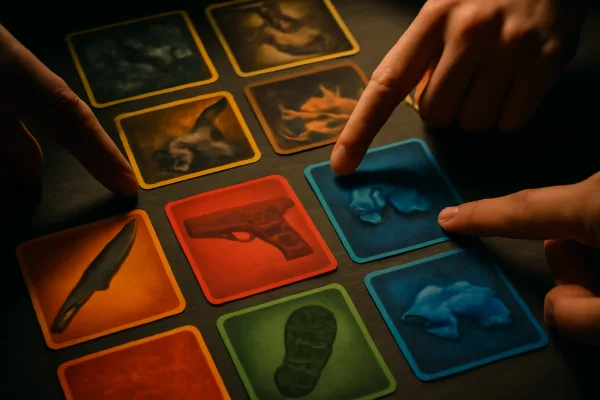
Deception: Murder in Hong Kong sits at a fascinating intersection of social deduction and puzzle-solving that no other game quite replicates. While most social deduction games ask “who is the traitor?”, Deception adds a second layer: “what was the murder weapon and what is the key evidence?” This dual mystery, combined with an asymmetric role system where one player communicates entirely through abstract tiles, creates a game experience that feels genuinely fresh even for veterans of the social deduction genre.
Designed by Tobey Ho and published by Grey Fox Games, Deception: Murder in Hong Kong accommodates 4 to 12 players in 20 to 30 minutes, making it one of the most versatile social deduction games available. It has earned consistently high praise from major review outlets, with a 7.5 rating on BoardGameGeek from over 25,000 reviews and a “Recommended” seal from Shut Up and Sit Down. The game is particularly celebrated for its ability to engage players who typically dislike lying-heavy social deduction games, because the Forensic Scientist role provides a cooperative deduction experience even within a hidden traitor framework.
This guide covers everything from the complete rules and role strategies to tips for teaching new players and running the game at different player counts.
How Deception Works: Complete Rules
Each player receives 4 Means cards (potential murder weapons like rope, poison, wrench) and 4 Clue cards (evidence like fingerprints, broken glass, blood stains) face-up in front of them. The Forensic Scientist, who knows the identity of the Murderer, must guide the investigators toward the correct Means and Clue cards using only abstract scene tiles.
The roles are distributed as follows:
| Role | Team | Players | Objective | Special Ability |
|---|---|---|---|---|
| Forensic Scientist | Good | Always 1 | Guide investigators to the correct murder weapon and evidence | Places markers on scene tiles to communicate abstract clues; cannot speak |
| Investigator | Good | Most players | Identify the Murderer’s Means and Clue cards | Discuss, accuse, and make one formal guess per round |
| Murderer | Evil | Always 1 | Avoid being identified | Knows their own Means and Clue; must misdirect investigators |
| Accomplice | Evil | 0-1 (6+ players) | Help the Murderer avoid detection | Knows the Murderer’s identity and chosen cards; assists with misdirection |
| Witness | Good | 0-1 (6+ players) | Help investigators without being identified by the Murderer | Knows the Murderer’s identity but NOT their chosen cards; must be subtle |
The game proceeds through three rounds. In each round, the Forensic Scientist reveals scene tiles showing categories like “Cause of Death,” “Location,” “Weather,” “Time of Day,” and places a marker on the option that best connects to the Murderer’s chosen cards. Investigators discuss the scene tiles, examine all players’ Means and Clue cards, and each get one formal accusation attempt per round — pointing to a specific player’s specific Means and specific Clue card.
If any Investigator correctly identifies both the Means and Clue card, the Investigators win. If all three rounds pass without a correct identification, the Murderer wins. If the Witness role is in play and the Investigators win, the Murderer gets one final chance: if they can identify the Witness, the Murderer wins instead.
Strategy for the Forensic Scientist
The Forensic Scientist is Deception’s most challenging and most creative role. You know the truth but cannot speak. Your only tools are scene tiles with abstract categories, and your task is to select the options that most clearly connect to the Murderer’s chosen Means and Clue cards.
Prioritize the most distinctive connection. Look at all the cards on the table and ask: what makes the Murderer’s chosen cards DIFFERENT from similar cards held by other players? If the Murderer chose “poison” as their Means, and two other players also have poison-related Means cards, pointing to “poison” on a scene tile will not help. Instead, find a connection that is unique to the Murderer’s specific card combination.
Use the first tile to narrow the field dramatically. Your first scene tile placement should eliminate as many suspects as possible. The “Cause of Death” tile is often the most impactful first choice because it directly narrows the Means card possibilities. If you select “Suffocation” and only one player has a suffocation-related Means card, investigators should be able to narrow their focus immediately.
Layer your communication across tiles. Each subsequent tile should add new information that builds on previous tiles. If your first tile indicated the location was indoors and your second tile indicates the victim was found lying down, investigators can cross-reference these details to identify cards that fit both criteria. This layered approach creates a cumulative picture that becomes clearer with each round. You might also enjoy our guide on Mysterium board game.
Watch the Murderer’s misdirection attempts. Pay attention to how the Murderer is steering the discussion. If the Murderer is successfully directing suspicion toward an innocent player, use your next tile placement to counteract the misdirection by providing information that clearly does not fit the falsely accused player’s cards.
“Playing the Forensic Scientist in Deception is like playing charades with abstract art while someone actively tries to confuse your audience. It is brilliant, frustrating, and addictive in equal measure.” — Shut Up and Sit Down review
Strategy for Investigators
Investigators must synthesize information from the Forensic Scientist’s tile placements, the behavior of other players during discussion, and logical analysis of all Means and Clue cards on the table.
Start with elimination, not identification. Look at the Forensic Scientist’s first tile placement and ask: which players’ cards are clearly NOT consistent with this clue? Eliminating suspects is more productive than guessing, especially in the first round when information is limited.
Cross-reference multiple tiles. Each tile provides one data point. Two tiles provide a pattern. Three tiles should provide enough information for a strong hypothesis. Track how each tile connects to different players’ cards and look for the player whose Means AND Clue cards are both consistent with ALL of the Forensic Scientist’s clues.
Watch for the Murderer’s behavioral tells. The Murderer knows which cards the Forensic Scientist is pointing toward. They may unconsciously react when discussion gets too close to their cards, or they may overcompensate by actively steering discussion away from their cards. Watch for players who seem unusually invested in redirecting discussion toward other suspects.
Coordinate with other investigators. Before making your formal accusation, discuss your theory with other investigators. If multiple investigators independently reach the same conclusion, the probability of being correct increases significantly. Save your formal accusation for when you are confident, because each player gets only one guess per round.
Strategy for the Murderer
The Murderer must misdirect investigators while appearing to participate genuinely in the investigation. This is a delicate balance: too quiet and you attract suspicion; too active and you may accidentally reveal information through your misdirection attempts.
Participate actively but strategically. Make observations about the Forensic Scientist’s tiles that are accurate but misleading. For example, if the Forensic Scientist places “outdoor location” and your chosen Means is a knife, point out that another player’s rope card would be perfect for an outdoor attack. This redirection uses real tile information to create a false narrative.
Never dismiss your own cards. If an investigator starts examining your cards, do not visibly panic or try to steer them away too aggressively. Instead, calmly engage with their analysis and subtly shift attention to a different card: “That is interesting, but I think the Forensic Scientist’s tile about the time of day points more toward Sarah’s flashlight card.” For additional reading, visit Deception on BoardGameGeek.
Blend your misdirection with genuine analysis. The best Murderers offer a mix of accurate observations (building credibility) and subtle misdirection (steering suspicion). If every comment you make points away from yourself, pattern-savvy investigators will notice. Mix in genuine analysis of other players to maintain the appearance of honest participation.
Teaching Deception to New Players
Deception is one of the easiest social deduction games to teach, but a clear explanation of the tile system prevents confusion during the first game.
The 2-minute pitch: “One of us is a murderer. One of us is a forensic scientist who knows who the murderer is but cannot speak — they can only give clues by pointing at options on these abstract tiles. The rest of us are investigators trying to figure out WHICH of the murderer’s cards are the murder weapon and the key evidence. We have three rounds to solve it.”
Show a demo round. Lay out sample cards and tiles. Show how the Forensic Scientist selects tile options to point toward specific cards. Then show how investigators should analyze the tiles and cross-reference with the cards on the table. This visual demonstration is worth more than 10 minutes of verbal explanation.
Start without the Accomplice and Witness. For the first game, use only the Forensic Scientist, Murderer, and Investigators. Add the Accomplice and Witness in the second game once everyone understands the core mechanics. These additional roles add strategic depth but can confuse new players who are still learning the basic tile communication system.
Player Count Recommendations
| Players | Roles | Game Feel | Recommendation |
|---|---|---|---|
| 4 | FS + Murderer + 2 Investigators | Very tight; almost puzzle-like | Functional but limited; better with more |
| 5-6 | FS + Murderer + Investigators | Good balance; focused discussion | Good for learning games |
| 7-8 | FS + Murderer + Accomplice + Witness + Investigators | Sweet spot; all roles active | Best overall experience |
| 9-12 | Full roles + extra Investigators | Chaotic; harder for Forensic Scientist | Party atmosphere; less strategic |
Why Deception Belongs in Every Collection
Deception: Murder in Hong Kong occupies a unique niche in the social deduction landscape. It is accessible enough for non-gamers (the core activity is looking at pictures and discussing them), deep enough for experienced players (the Forensic Scientist role is endlessly challenging), quick enough for a weeknight game (20 to 30 minutes), and scalable enough for both intimate gatherings and large parties (4 to 12 players).
Perhaps most importantly, Deception solves the biggest problem with traditional social deduction games: the requirement for everyone to be a convincing liar. In Deception, only the Murderer needs to deceive. The Forensic Scientist provides a satisfying cooperative experience for players who prefer puzzle-solving over deception. And the Investigators get to exercise their analytical skills without the pressure of maintaining a secret identity. This role diversity means that everyone in your group, from the theatrical performers to the analytical thinkers to the cooperative players, can find a role that matches their strengths and preferences. For more on this topic, check out our article about social deduction games.
At $25 to $40 for a game that accommodates 4 to 12 players and plays in under 30 minutes, Deception offers outstanding value. It is the game we recommend most often for groups who want social deduction without the intensity of Werewolf or the time commitment of Blood on the Clocktower.
Conclusion
Deception: Murder in Hong Kong is a masterpiece of accessible game design that brings the thrill of solving a murder to any group in under 30 minutes. Its unique combination of abstract communication, hidden role deduction, and collaborative investigation creates an experience that stands apart from every other game in the genre. Whether you are looking for your first social deduction game or your tenth, Deception deserves a prominent place in your collection.
Found this helpful? Share it with your game night crew.
Frequently Asked Questions
Is Deception better than Mysterium?
They serve different purposes. Mysterium is fully cooperative with no hidden traitor, while Deception includes a hidden Murderer who works against the group. Mysterium is more atmospheric and story-driven, while Deception is faster-paced and more directly competitive. Many groups own and enjoy both for different occasions.
Can the Forensic Scientist make any gestures or sounds?
No. The Forensic Scientist cannot speak, point, gesture, nod, shake their head, or make any sounds that communicate information. Their ONLY communication tool is the scene tiles. This constraint is what makes the role so challenging and creative.
What happens if the Murderer’s cards are really obvious?
Occasionally the Forensic Scientist gets scene tiles that make the connection very obvious. In these cases, the game becomes about the Murderer’s ability to redirect suspicion and the Accomplice’s ability to support the misdirection. These “easy solve” games are less common than they seem because the Murderer has 8 cards (4 Means + 4 Clue) that investigators must sort through, and even an obvious single connection can be obscured when multiple players have similar cards.
Is there a way to make the game harder for experienced groups?
Yes. Reduce the number of rounds from 3 to 2 for a more challenging experience. Add more Means and Clue cards per player (5 or 6 instead of 4) to increase the number of options investigators must evaluate. Or use the Accomplice and Witness roles, which add complexity to both the investigation and the deception.
Does Deception have any expansions?
Yes. Deception: Undercover Allies adds new roles (the Lab Technician who can analyze evidence, and the Inside Man who knows one card but not who holds it), new Means and Clue cards, and new scene tiles. The expansion is recommended for groups who have played the base game 10+ times and want fresh content. Learn more at social deduction.
Advanced Game Variants and House Rules
After many sessions of Deception, experienced groups often introduce house rules and variants that add freshness to the core experience. These modifications are community-tested and widely recommended by regular players.
The Timed Discussion Variant: Instead of free-flowing discussion during each round, set a 3-minute timer. When the timer runs out, discussion stops and accusations must be made immediately. This variant creates urgency that forces faster decision-making and prevents the analysis paralysis that can slow down experienced groups. It also gives the Murderer less time to construct elaborate misdirection narratives.
The Double Murderer Variant (8+ players): Include two Murderers who each have their own set of target Means and Clue cards. The Forensic Scientist must provide clues that point to both sets of targets simultaneously, and investigators must identify both Murderers and their respective cards. This variant is extremely challenging for the Forensic Scientist but creates intense, multi-layered investigations that experienced groups find deeply satisfying.
The Silent Discussion Variant: During one round (typically the second), investigators must discuss exclusively through written notes passed between players. This variant adds a new communication challenge, eliminates the advantage of verbally dominant players, and creates hilarious situations where misinterpreted notes lead to wildly wrong accusations.
The Hidden Cards Variant: Instead of playing with all Means and Clue cards face-up, each player has 2 cards face-up and 2 cards face-down. Investigators can request to see a player’s face-down cards, but each investigator can only make 2 such requests per game. This variant adds a resource management element and forces investigators to be strategic about where they invest their limited information-gathering actions.
Campaign Mode: Play 5 games in sequence where the Murderer role rotates and each player earns points based on their performance: 2 points for being on the winning team, 1 bonus point for making the correct accusation as an Investigator, 1 bonus point for surviving as the Murderer, and 1 bonus point for correctly identifying the Witness. The player with the most points after 5 games is the ultimate detective. This format turns a casual game night into an epic competition that spans the entire evening.
Deception vs Other Party Deduction Games
Understanding how Deception compares to similar games helps you decide whether it fills a gap in your collection or overlaps with games you already own. We also have a great resource on murder mystery party that you might find helpful.
| Feature | Deception | Mysterium | Codenames | Werewords | A Fake Artist Goes to New York |
|---|---|---|---|---|---|
| Players | 4-12 | 2-7 | 4-8+ | 4-10 | 5-10 |
| Time | 20-30 min | 45-60 min | 15-30 min | 10-15 min | 15-20 min |
| Hidden traitor? | Yes | No | No | Yes | Yes |
| Non-verbal communicator? | Yes (Forensic Scientist) | Yes (Ghost) | Semi (Spymaster gives 1 word) | Semi (Mayor nods/shakes) | No |
| Puzzle element? | Strong (identify Means + Clue) | Strong (identify Suspect + Location + Object) | Moderate (word associations) | Moderate (word guessing) | Low (drawing identification) |
| Lying required? | Murderer only | None | None | Werewolf only | Fake Artist only |
| Best for | Groups who want deduction + hidden traitor | Cooperative groups who love visual art | Word game lovers, team play | Quick filler, word game fans | Creative groups, drawing fans |
Deception’s closest competitors are Mysterium (similar non-verbal communication but fully cooperative) and Werewords (similar hidden traitor but with word guessing instead of card analysis). If you own Mysterium and want to add a competitive hidden traitor element, Deception is the natural complement. If you own Werewords and want a deeper investigation experience, Deception provides significantly more strategic depth in a similar time frame.
The game that most often gets compared to Deception is Clue, and the comparison is illuminating. Both games involve identifying a murder weapon and associated evidence. But where Clue is a methodical elimination puzzle with no social interaction, Deception is an intensely social experience where human communication, misdirection, and group dynamics determine the outcome. Deception is what Clue would be if it were designed for the modern board gaming renaissance, and that makes it a compelling upgrade for anyone who grew up loving Clue and wants a richer, more engaging murder mystery experience.
For game collections that already include one social deduction game, Deception earns its shelf space by being fundamentally different from pure deception games like Werewolf or Secret Hitler. Its puzzle-solving core engages analytical players who might not enjoy traditional lying-and-accusing games, while its hidden Murderer role satisfies players who crave the thrill of deception. This dual appeal makes Deception one of the most versatile social deduction games available and explains why it consistently appears on recommended game lists across the board gaming community.
Where to Buy and What Comes in the Box
Deception: Murder in Hong Kong is widely available through multiple retail channels. The standard retail edition typically costs between twenty-five and forty dollars, making it one of the more affordable social deduction games with a premium production quality. The game is available on Amazon, at local board game stores, at major retailers like Target and Barnes and Noble, and through online board game retailers like CoolStuffInc and Miniature Market.
The box includes everything needed to play: 200+ Means and Clue cards providing enormous variety across sessions, 32 scene tiles covering categories from location and weather to victim identity and cause of death, role cards for all five roles, evidence badges for formal accusations, bullet markers for the Forensic Scientist’s tile placements, and a comprehensive rulebook with illustrated examples. The card quality is excellent, with a linen finish that prevents sticking and wear, and the scene tiles are printed on thick cardboard that withstands repeated handling.
For groups who play frequently, the Undercover Allies expansion adds substantial content: new roles that change the social dynamics, additional Means and Clue cards that prevent card memorization, and new scene tiles that give the Forensic Scientist fresh communication options. The expansion integrates seamlessly with the base game and is recommended once the base game content starts to feel familiar, typically after fifteen to twenty sessions.
One practical note about storage: the original box insert does not organize the cards efficiently for quick setup. Many regular players purchase small plastic bags or card dividers to sort Means cards, Clue cards, and scene tiles separately. This simple organizational step reduces setup time from five minutes to under two minutes, which makes a significant difference when you want to play multiple games in one evening. Some community members have shared free printable insert designs that fit the original box and provide dedicated compartments for each component type.