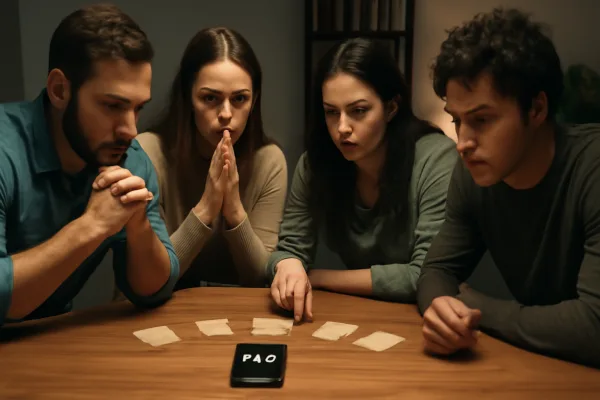
One Night Ultimate Werewolf distills the entire social deduction experience into a single, explosive 10-minute round that leaves players breathless, laughing, and immediately demanding another game. Created by Ted Alspach and published by Bezier Games, One Night takes the classic Werewolf formula and reinvents it completely: there is no moderator needed (a free companion app handles the night phase), there is no player elimination (everyone plays until the final vote), and the roles do not just define your team — they actively shuffle the cards during the night, meaning players may not even know their own identity when the discussion phase begins.
Since its release in 2014, One Night Ultimate Werewolf has sold over 2 million copies and maintained a 7.1 rating on BoardGameGeek from over 45,000 reviews. It has spawned several expansions (Daybreak, Vampire, Alien, Super Villains) that add new roles and mechanics while maintaining the core one-night format. For groups of 3 to 10 players who want maximum social deduction excitement in minimum time, One Night is the undisputed champion.
This guide covers every role in the base game, advanced strategies that experienced players use to dominate, the best role combinations for different group sizes, and tips for getting the most out of the companion app.
How One Night Works: The Complete Flow
One Night plays in three phases that together last approximately 10 minutes:
Setup: Each player receives one face-down role card. Three additional role cards are placed face-down in the center of the table. These center cards are crucial — some night actions involve swapping center cards with player cards, meaning roles can change during the night.
Night Phase (managed by the app, ~3 minutes): All players close their eyes. The app narrates the night phase, calling each role in order to perform their action. Roles may look at other cards, swap cards, or gain information. Players keep their eyes closed except when specifically called by the app.
Day Phase (5-10 minutes of discussion + vote): All players open their eyes. A timed discussion period begins (typically 5 minutes for beginners, 3 minutes for experienced groups). Players discuss, accuse, claim roles, and try to figure out what happened during the night. When the timer ends, all players simultaneously point at the player they want to eliminate. The player with the most votes is eliminated. If that player is a Werewolf, the Village wins. If that player is not a Werewolf, the Werewolves win. If no one receives more than one vote, no one is eliminated, and the Werewolves win only if there is at least one Werewolf among the players.
| Phase | Duration | What Happens | Key Skill |
|---|---|---|---|
| Setup | 1 minute | Deal roles, place 3 in center | N/A |
| Night | 2-3 minutes | Roles perform actions; app narrates | Memory, attention |
| Day Discussion | 3-10 minutes | Open discussion, accusations, claims | Deduction, persuasion, bluffing |
| Vote | 10 seconds | Simultaneous pointing; majority eliminated | Timing, reading the room |
Every Role Explained
Understanding every role is essential because the game’s strategy revolves around predicting what happened during the night based on the roles that are in play. Here is every role in the base game:
Werewolf (Evil Team): During the night, Werewolves open their eyes and identify each other. If there is only one Werewolf among the players, that Werewolf may look at one center card. The Werewolves’ goal is to avoid being voted out. They win if a non-Werewolf player is eliminated.
Minion (Evil Team): The Minion sees who the Werewolves are, but the Werewolves do not know who the Minion is. The Minion wins with the Werewolf team. If the Minion is voted out but no Werewolf is, the Werewolves still win. The Minion’s job is to draw suspicion to themselves, protecting the actual Werewolves.
Seer (Village Team): The Seer may look at one other player’s card OR two center cards. This provides critical information: either confirming one player’s identity or revealing which roles are NOT assigned to any player. You might also enjoy our guide on classic Werewolf.
Robber (Village Team): The Robber swaps their card with another player’s card and looks at their new card. After the swap, the Robber IS their new role. If the Robber steals a Werewolf card, the Robber is now a Werewolf and must play accordingly. The original Werewolf is now the Robber and on the Village team, though they do not know it.
Troublemaker (Village Team): The Troublemaker swaps two OTHER players’ cards without looking at them. Neither of those players knows their role has changed. This creates chaos that can accidentally help or hinder either team.
Drunk (Village Team): The Drunk swaps their card with a center card WITHOUT looking at it. The Drunk no longer knows their own role. They might still be the Drunk, or they might be a Werewolf, a Villager, or anything else that was in the center.
Insomniac (Village Team): The Insomniac wakes up at the END of the night phase and looks at their own card. This confirms whether their role was changed by the Robber, Troublemaker, or Drunk. The Insomniac is one of the most powerful information roles because they know their current identity with certainty.
Hunter (Village Team): The Hunter has no night action. If the Hunter is voted out, the player they are pointing at is also eliminated. This creates a deterrent against voting out the Hunter and a powerful threat that the Hunter can use during discussion.
Tanner (Independent): The Tanner wants to be voted out. If the Tanner is eliminated, only the Tanner wins (regardless of Werewolf survival). The Tanner acts as suspicious as possible during discussion, trying to convince the village to vote for them. The Tanner’s existence forces the village to consider: is this person acting suspiciously because they are a Werewolf, or because they are a Tanner trying to get voted out?
Villager (Village Team): The Villager has no night action and no special ability. Villagers participate in discussion and voting using only the information gathered from other players’ claims. Despite the apparent simplicity, Villagers play a crucial analytical role.
“One Night Ultimate Werewolf proves that you do not need two hours and twenty players to create unforgettable social deduction moments. Ten minutes and five friends is all it takes.” — Tom Vasel, The Dice Tower
Advanced Strategies by Role
Werewolf strategy: Your primary strategy is to claim a Village role convincingly. The most common Werewolf claims are Villager (safe but uninformative — experienced groups will challenge this), Insomniac (claim you checked your card and it was unchanged), or a role that is in the center (if you peeked at a center card as a lone Werewolf and saw the Seer, you can safely claim to be the Seer). The key is to have a consistent story prepared BEFORE discussion begins. Stumbling over your claim is the number one way Werewolves get caught.
Seer strategy: If you looked at a player’s card and found a Werewolf, announce it immediately and confidently. If you looked at center cards, share what you found — revealing which roles are in the center helps the village identify false claims. The Seer is the most powerful information role and should speak early in the discussion to establish the information framework. For additional reading, visit One Night on BoardGameGeek.
Robber strategy: Always announce what card you stole. “I robbed Alex and I am now the Villager” gives the village two pieces of information: your confirmed identity AND Alex’s current role. If you stole a Werewolf card, you are now a Werewolf and must play for the evil team — claim a Village role and try to protect the player you stole from (who is now unknowingly on the Village team).
Troublemaker strategy: Announce which two players you swapped. “I swapped Alex and Sarah.” This forces Alex and Sarah to reconsider their identities. If one of them was a Werewolf, they are now innocent (and the person they were swapped with is now a Werewolf who does not know it). This information is critical for the village’s voting decision.
Tanner strategy: Act just suspicious enough to get votes but not so obviously that experienced players identify you as a Tanner. The best Tanner strategy is to claim a powerful role (like Seer) and then provide information that is slightly but detectably wrong. This creates exactly the level of suspicion that makes the village want to vote you out. Too much suspicion and they will suspect Tanner; too little and they will ignore you.
Best Role Combinations by Player Count
| Players | Roles in Play | Center Cards | Game Feel |
|---|---|---|---|
| 3 | 2 Werewolves, Seer + 3 center | Robber, Troublemaker, Villager | Very quick; almost a puzzle |
| 4 | 2 Werewolves, Seer, Robber + 3 center | Troublemaker, Villager, Villager | Fast; limited information |
| 5 | 2 Werewolves, Seer, Robber, Troublemaker + 3 center | Villager, Villager, Drunk | Sweet spot for learning |
| 6-7 | Add Insomniac, Drunk, Hunter | Varies | Great balance of info and chaos |
| 8-10 | Add Minion, Tanner, extra Villagers | Varies | Maximum chaos; best for experienced groups |
For your first game, use 5 players with the recommended beginner setup: 2 Werewolves, Seer, Robber, Troublemaker, and 3 center cards (Villager, Villager, Drunk). This setup provides enough information for meaningful deduction while keeping complexity manageable. Add roles one at a time in subsequent games as the group becomes comfortable.
Using the Companion App Effectively
The free One Night companion app (available for iOS and Android) is essential for the best experience. It narrates the night phase in a consistent, atmospheric voice, ensures roles are called in the correct order, and provides background music and sound effects that enhance the atmosphere.
App settings to customize:
- Night phase duration: Default timing works well, but you can extend pauses between roles for groups that need more time to perform their actions.
- Day phase timer: Start with 5 minutes for beginners and reduce to 3 minutes as the group gets faster. Tighter timers create more pressure and force quicker decisions.
- Background music: The app includes atmospheric music that enhances the experience. Keep it enabled for the first several games; disable it if your group finds it distracting.
- Role narration: The app narrates each role’s instructions. This is essential for new players but can be turned off for experienced groups who know all roles by heart.
Common Mistakes and How to Avoid Them
Opening your eyes at the wrong time. During the night phase, only open your eyes when YOUR role is called. Opening early or late reveals your role to other players who might be peeking. The app’s narration makes this clear, but excitement and nervousness can cause mistakes. Experienced groups develop a discipline of keeping eyes firmly closed until specifically prompted.
Claiming a role too quickly. In the heat of discussion, some players immediately announce their role before hearing what others claim. This is suboptimal for both teams. Village players benefit from hearing claims in sequence (to identify contradictions), and Werewolves benefit from hearing Village claims first (so they can claim an unclaimed role). Let the conversation develop before committing to a claim. For more on this topic, check out our article about Among Us strategy.
Ignoring the center cards. New players often forget that 3 cards are in the center and not assigned to any player. If the Seer checked center cards or the Drunk swapped with a center card, this information dramatically changes the deduction landscape. Always ask during discussion whether anyone has information about center cards.
Vote splitting. The Werewolves win if no single player receives more than one vote (and there is at least one Werewolf in play). This means the village must coordinate their votes. In the final seconds before the vote, experienced Village players will loudly call for vote coordination: “Everyone vote for Alex on three!” Splitting the vote between multiple suspects is the most common way the Werewolves steal victories.
Expanding with Daybreak and Other Expansions
Once your group has mastered the base game, the Daybreak expansion adds new roles that dramatically change the strategic landscape. Key Daybreak roles include:
Mystic Wolf: A Werewolf who can also look at one player’s card during the night, gaining Seer-like information for the evil team. This powerful role makes the Werewolf team significantly stronger and is recommended for groups where the Village wins most games.
Alpha Wolf: A Werewolf who swaps a center card with another player’s card, potentially creating an unwitting third Werewolf. This adds an unpredictable element that even the Werewolves cannot fully control.
Sentinel: A Village role that places a shield token on another player’s card, preventing it from being moved by the Robber, Troublemaker, or other card-moving roles. The Sentinel provides protection and information, as a shielded player knows their role was not changed during the night.
Apprentice Seer: A weaker version of the Seer who can look at only one center card. Useful for adding more information to games without the full power of the original Seer.
Additional expansions, including Vampire, Alien, and Super Villains, add entirely new team mechanics and game modes. These expansions are recommended only for groups who have thoroughly explored the base game and Daybreak and are looking for substantially different experiences within the One Night framework. Learn more at Ultimate Werewolf.
Why One Night Belongs in Every Game Collection
Every game collection needs a quick, universally enjoyable game that can be played as a warm-up, a filler between heavier games, or the star of a casual evening. One Night Ultimate Werewolf fills this role perfectly. Its 10-minute play time means you can play 5 to 8 games in an hour, each one generating its own memorable moments. Its 3-10 player range covers virtually every social situation. Its rules can be taught in 2 minutes. And its combination of deduction, bluffing, and social interaction creates the core experience that defines the social deduction genre.
At $15 to $25 for the base game, One Night offers extraordinary value. The game includes enough roles for hundreds of unique configurations, the free companion app eliminates the need for a moderator, and the compact box fits in a jacket pocket for easy transport. Whether you are building your first game collection or your hundredth, One Night Ultimate Werewolf earns its place.
Conclusion
One Night Ultimate Werewolf proves that great social deduction does not require hours of commitment or dozens of players. In just 10 minutes, it creates the full spectrum of social deduction emotions: suspicion, trust, betrayal, triumph, and the incomparable thrill of a perfectly executed bluff. The role-swapping mechanic adds a layer of uncertainty that keeps even veteran players guessing, and the quick play time ensures that every loss is immediately forgiven in the excitement of the next round.
Gather your friends, download the app, deal the cards, and close your eyes. When you open them, the real game begins.
Found this helpful? Share it with your game night crew.
Frequently Asked Questions
Do I need the app to play One Night Ultimate Werewolf?
While technically playable with a human moderator, the free companion app provides a dramatically better experience. It ensures consistent timing, atmospheric narration, and correct role ordering. The app is free and available for both iOS and Android devices. We strongly recommend using it for every game.
Can children play One Night Ultimate Werewolf?
The game is recommended for ages 8 and up. The deception element may be challenging for younger children, but the short game length means even a confusing game is over quickly. Start with simple role combinations (Werewolves, Seer, Villagers only) for younger players and add complex roles as they become comfortable with the format.
What if someone accidentally sees another player’s card during the night?
The official rule is to continue playing. Night phase accidents happen, especially with new players. The affected player should try to disregard the information they saw. If the issue becomes frequent, ensure that players are sitting far enough apart that accidental card viewing is physically impossible. We also have a great resource on mystery parties for kids that you might find helpful.
How is One Night different from regular Werewolf?
Traditional Werewolf plays over multiple rounds with player elimination, requires a moderator, and can last 30 to 60 minutes. One Night compresses the entire experience into a single night-and-day cycle with no elimination, uses an app instead of a moderator, and lasts 10 minutes. The role-swapping mechanic in One Night is completely absent from traditional Werewolf. Both games are excellent but serve very different purposes.
Which expansion should I buy first?
Daybreak is the recommended first expansion. It adds the most universally useful roles (Mystic Wolf, Sentinel, Alpha Wolf) and integrates seamlessly with the base game. The other expansions (Vampire, Alien, Super Villains) add more dramatic changes to the core formula and are better suited for groups who have fully explored the base game and Daybreak.
Teaching One Night to First-Time Players
The fastest way to teach One Night Ultimate Werewolf is to play a demo round. Explain the three phases in 60 seconds: during the night everyone closes their eyes and roles do their thing through the app, during the day everyone discusses and accuses, then everyone votes simultaneously. Then deal cards and play. People learn social deduction games by playing, not by listening to rules explanations.
For the teaching round, use a simplified role set: 2 Werewolves, 1 Seer, and Villagers for the remaining players, with 3 Villagers in the center. This minimal setup teaches the core flow without overwhelming new players with role-swapping mechanics. After the first round (which takes about 8 minutes), add the Robber and Troublemaker for the second round. By the third round, most groups are ready for the full role set.
One critical teaching tip: emphasize that the vote is SIMULTANEOUS. New players sometimes try to vote sequentially (going around the table), which allows the last voters to follow the crowd. Everyone must point at the same time on the count of three. This simultaneous vote is what creates the dramatic, unpredictable endings that make One Night so exciting.
Another common teaching challenge is explaining that your role can CHANGE during the night. Many new players struggle with the concept that they went to sleep as the Seer but might wake up as a Werewolf because the Robber stole their card. Emphasize this clearly before the first game: your starting role determines your night action, but your FINAL role (which may have been changed by the Robber, Troublemaker, or Drunk) determines your team and your win condition. This distinction is the core of One Night’s strategic depth and the source of its most memorable moments.
The beauty of One Night as a teaching game is that even a disastrous first round where nobody understands what happened is still fun. The confusion itself generates laughter and conversation that naturally leads to understanding. By the third or fourth round, even the most confused new player has internalized the mechanics and is fully engaged in the deduction and social manipulation that make the game special. Let the game teach itself through play, and resist the urge to over-explain before the first deal.