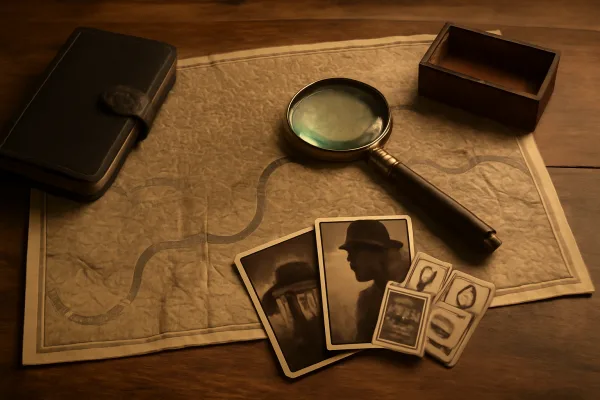
Detective board games have evolved far beyond the simple roll-and-move mechanics of classic Clue. Modern detective games put you in the shoes of an actual investigator, presenting you with case files, witness statements, forensic evidence, and crime scene photographs that you must analyze to identify the culprit. These games challenge your logical reasoning, attention to detail, and ability to connect seemingly unrelated pieces of information, delivering the intellectual satisfaction of solving a real puzzle without leaving your dining room table.
The detective board game category has experienced explosive growth over the past five years, driven by the same cultural forces that fueled the true crime podcast boom and the escape room industry. Publishers like Portal Games, Space Cowboys, and Asmodee have invested heavily in the category, producing games with production values that rival premium entertainment experiences. The result is a golden age for tabletop detective gaming, with options ranging from quick 30-minute whodunits to sprawling campaign-style investigations that unfold across dozens of hours.
This guide reviews 8 of the best detective board games available, covering every style from cooperative deduction puzzles to competitive investigations to solo-friendly mysteries. Each review includes gameplay overview, complexity assessment, time commitment, player count recommendations, and our verdict on who will enjoy it most.
1. Sherlock Holmes Consulting Detective
Players: 1-8 | Time: 60-120 min per case | Price: $35-50 | Cases: 10 per box | Complexity: Medium-High
Sherlock Holmes Consulting Detective is the grandfather of modern detective board games and arguably still the best pure deduction experience in tabletop gaming. Each case presents you with a newspaper, a map of Victorian London, a casebook containing numbered entries for locations you can visit, and a mystery to solve. There are no dice, no cards, no luck elements whatsoever. It is purely your ability to read, analyze, and connect information against the legendary detective himself.
The gameplay is beautifully simple: read the introduction to the case, decide which locations to visit (each location reveals a numbered paragraph in the casebook containing witness statements, evidence, or red herrings), and when you believe you have solved the mystery, turn to the solution and answer a series of questions. Your score is based on how many locations you visited compared to how many Holmes needed — he always solves it in fewer visits, the smug genius.
What makes Consulting Detective special is the depth of its case files. Each case is a genuine literary mystery that rewards careful reading and lateral thinking. The witnesses lie. The evidence is ambiguous. Red herrings abound. And the solution often hinges on a detail that was hiding in plain sight but that you overlooked because you were chasing a more exciting lead. This experience replicates the actual process of detective work more authentically than any other game in the genre.
| Game | Players | Time | Price | Style | Replayability | Rating |
|---|---|---|---|---|---|---|
| Sherlock Holmes Consulting Detective | 1-8 | 60-120m | $35-50 | Pure deduction, casebook | Low (once solved) | 9.0 |
| Chronicles of Crime | 1-4 | 60-90m | $30-40 | App-enhanced, VR scenes | Low (once solved) | 8.5 |
| Detective: A Modern Crime Board Game | 1-5 | 120-180m | $40-50 | Database research, realism | Low | 8.3 |
| Clue (updated editions) | 2-6 | 30-60m | $15-25 | Classic elimination | High | 7.0 |
| Mysterium | 2-7 | 45-60m | $30-45 | Ghost communication | High | 8.2 |
| MicroMacro: Crime City | 1-4 | 15-30m | $20-30 | Where’s Waldo meets mystery | Low | 8.0 |
| Cryptid | 3-5 | 30-50m | $25-35 | Competitive deduction | Very High | 8.4 |
| Suspects | 1-5 | 60-90m | $20-30 | Claire Harper investigates | Low | 7.8 |
Best for: Readers, literature lovers, and anyone who wants the most authentic detective experience available in tabletop form. Perfect for couples and small groups who enjoy discussion-heavy games. The game works brilliantly solo as a pure puzzle experience.
2. Chronicles of Crime
Players: 1-4 | Time: 60-90 min per case | Price: $30-40 | Complexity: Medium
Chronicles of Crime brings detective gaming into the digital age with a companion app that uses QR codes and virtual reality technology to create immersive crime scenes. Physical board components include location cards and character cards, each with a unique QR code. Scanning a character’s code at a location triggers an in-app conversation where you can ask questions about the case. Scanning the crime scene itself launches a 360-degree VR view (using your phone as a viewer or optional VR headset) where you search for physical evidence.
The app integration solves several problems that plague traditional detective games. It eliminates the need for massive casebooks, allows for more dynamic storytelling (the app tracks which clues you have found and adjusts NPC responses accordingly), and enables the VR crime scene inspection that is genuinely thrilling the first few times you use it. The downside is the dependency on the app — if your phone dies or the app servers go down, the game is unplayable.
With multiple expansion modules covering different time periods (Noir for 1950s mysteries, 1400 for medieval mysteries, 2400 for sci-fi mysteries), Chronicles of Crime offers a breadth of thematic variety that no other detective game matches. Each module provides 4 to 5 self-contained cases with distinct atmospheres and investigation styles. You might also enjoy our guide on mystery video games.
Best for: Tech-savvy groups who want a modern, app-enhanced detective experience. The VR crime scene feature is a genuine wow factor for first-time players. Excellent for solo play.
3. Detective: A Modern Crime Board Game
Players: 1-5 | Time: 120-180 min per case | Price: $40-50 | Complexity: High
If Sherlock Holmes Consulting Detective is the literary approach to detective gaming, Detective: A Modern Crime Board Game is the procedural approach. Published by Portal Games, Detective tasks you with solving cases using a combination of physical case files, an online database (Antares) that you access via a real web browser, and a time management system that forces you to prioritize which leads to follow within your limited investigation hours.
The Antares database is what makes Detective unique. As you investigate, you can search the database for suspect records, forensic reports, and cross-references that feel remarkably like accessing a real police database. The game even encourages you to use Google to research real-world topics that are relevant to the case — a design choice that blurs the line between game and reality in a way that is both innovative and slightly unsettling.
Detective is not for casual players. Cases run 2 to 3 hours each, the five interconnected cases in the base game form a single overarching narrative that takes 10 to 15 hours to complete, and the difficulty level is genuinely challenging. But for groups who want the most realistic, immersive detective experience available in tabletop form, nothing else comes close.
Best for: Dedicated gaming groups who want a serious, multi-session detective campaign. The time commitment is significant but the payoff is extraordinary. Not recommended for casual one-off game nights.
“Detective: A Modern Crime Board Game made me feel more like an actual detective than any game I have ever played. The database research, the time pressure, the interconnected cases — it is the closest thing to being a real investigator that you can experience at your dining room table.” — Board Game Quest review
4. MicroMacro: Crime City
Players: 1-4 | Time: 15-30 min per case | Price: $20-30 | Complexity: Low
MicroMacro takes a completely different approach to detective gaming. Instead of reading casebooks or searching databases, you solve crimes by examining an enormous, incredibly detailed city map that depicts Crime City from a bird’s eye view. Each case asks you to follow a sequence of events frozen in time across the map: find the victim, trace their movements backward, identify the suspect, and determine the motive by observing the detailed scenes illustrated throughout the city.
The concept is brilliantly simple — it is essentially Where’s Waldo meets murder mystery — but the execution is remarkable. The map is packed with thousands of tiny figures, each telling a story through their frozen actions and expressions. Following a suspect’s path across the map, discovering their secret meetings, their weapon acquisition, and their escape route creates a genuine sense of detective accomplishment that is incredibly satisfying.
MicroMacro is the most accessible detective game on this list by a wide margin. There are no rules to learn beyond “look at the map and follow the case cards.” Children as young as 8 can participate meaningfully. And the 15 to 30 minute case length makes it perfect for quick detective sessions between other activities.
Best for: Families, casual groups, and anyone who wants detective fun without rules overhead. The perfect gateway to detective gaming for people who do not typically play board games. Also excellent as a warm-up activity before heavier detective games. For additional reading, visit BoardGameGeek.
5. Cryptid
Players: 3-5 | Time: 30-50 min | Price: $25-35 | Complexity: Medium
Cryptid stands apart from every other game on this list because it is the only purely competitive deduction game in the group. Each player has one unique clue about the location of a mysterious creature on a hex-map board. By asking yes-or-no questions about other players’ clues and analyzing the information revealed through those questions, you must determine the cryptid’s exact location before anyone else does.
The genius of Cryptid is that every piece of information is simultaneously useful to you and dangerous. Asking a question reveals information to all players, not just you. Answering a question honestly (as the rules require) gives away a clue about your secret information. This creates a delicious tension between needing information and not wanting to give it away, which makes every turn a meaningful strategic decision.
Unlike the other detective games reviewed here, Cryptid has virtually infinite replayability because the puzzle is generated fresh for every game using a setup system that ensures a unique solvable configuration. You will never play the same puzzle twice, making Cryptid a permanent addition to your game night rotation rather than a play-once-and-shelf experience.
Best for: Groups who enjoy competitive logical deduction and do not mind a game where information management is as important as puzzle-solving. Excellent for regular game groups who want a detective-style game they can play every week.
6-8: Quick Reviews
6. Clue (Modern Editions)
Players: 2-6 | Time: 30-60 min | Price: $15-25
The classic that started it all. While modern detective games have surpassed Clue in complexity and immersion, the original formula of elimination-based deduction remains satisfying and accessible. Recent themed editions, including Harry Potter Clue, The Office Clue, and Disney Clue, have revitalized the brand for new audiences. Clue’s greatest strength is its universal recognizability and its gentle learning curve, making it the perfect choice for mixed-age family gatherings. For groups ready for deeper detective experiences, any game above on this list provides a significant upgrade, but Clue remains a worthy starting point.
7. Suspects
Players: 1-5 | Time: 60-90 min per case | Price: $20-30 For more on this topic, check out our article about board game cafes.
Suspects features recurring detective Claire Harper solving cases in 1930s California using a card-based investigation system. Each case provides a deck of cards representing locations, witnesses, and evidence. You choose which cards to examine, knowing that each card examined costs investigation time and lowers your final score. The scoring system creates a compelling risk-reward dynamic: examine more cards for more information, or solve the case with fewer cards for a higher score. The art deco aesthetic and noir atmosphere are gorgeous.
8. Awkward Guests
Players: 1-8 | Time: 45-75 min | Price: $25-40
Awkward Guests is a competitive deduction game where players gather clues about a murder by trading information cards with each other. The trading mechanic is what makes it unique: you must give information to receive information, creating a constant negotiation about what to share and what to withhold. With over 3,000 possible case configurations generated by the card combinations, the game offers extraordinary replayability. It successfully captures the feeling of Clue while adding substantially more depth, strategic trading, and social interaction.
How to Choose the Right Detective Board Game
With so many excellent options available, the right detective game for you depends on your group’s specific characteristics and preferences:
| If You Want… | Choose This | Why |
|---|---|---|
| The deepest investigation experience | Sherlock Holmes Consulting Detective | Pure deduction with no mechanics getting in the way |
| Modern tech integration | Chronicles of Crime | App + VR creates a unique multimedia experience |
| Maximum realism | Detective: A Modern Crime Board Game | Real database research and time management simulation |
| Quick, accessible fun | MicroMacro: Crime City | No rules to learn; visual puzzle that anyone can enjoy |
| Competitive deduction | Cryptid | Infinite replayability with a unique information-trading mechanic |
| Classic family gaming | Clue (any edition) | Universal recognition, simple rules, great for mixed ages |
| Noir atmosphere | Suspects | Beautiful art deco design with clever scoring system |
| Social trading + deduction | Awkward Guests | Competitive Clue with 3000+ case combinations |
Building a Detective Game Collection on a Budget
Detective board games tend to have limited replayability because once you solve a case, you know the answer. However, this does not mean they offer poor value. A $40 game with 10 cases that each provide 90 minutes of entertainment delivers 15 hours of gameplay for approximately $2.67 per hour — cheaper than a movie, an escape room, or almost any other entertainment option.
To maximize your detective gaming budget, consider these strategies:
Start with high-replay games. Cryptid and Awkward Guests offer essentially infinite replayability, making them the best value propositions in the genre. Buy one of these as your permanent collection cornerstone and supplement with solve-once games as special purchases.
Share and trade. Since detective games are typically played once by each group, they are perfect candidates for sharing with friends or trading through board game communities. Play through your copy, then swap it for a friend’s completed copy. Many local board game groups organize formal or informal trading circles for this purpose.
Explore the second-hand market. Solve-once detective games in good condition frequently appear on eBay, Facebook Marketplace, and the BoardGameGeek marketplace at significant discounts. A game that retails for $40 can often be found for $15 to $25 in the second-hand market, sometimes with cases that the previous owner never played. Learn more at Cluedo.
Check your local library. Many public libraries now lend board games, and detective games are among the most frequently stocked categories. This allows you to play through an entire game for free before deciding whether to purchase your own copy or move on to the next title. Library board game collections have expanded significantly in recent years, and requesting a specific title for acquisition is usually welcomed.
The Future of Detective Board Games
The detective board game genre continues to innovate, with several exciting developments on the horizon. Augmented reality integration, where physical game components trigger digital overlays visible through smartphone cameras, is being tested by multiple publishers. AI-generated cases that provide truly unlimited replayability are in early development. And hybrid physical-digital experiences that combine tabletop components with companion apps are becoming increasingly sophisticated.
For detective game enthusiasts, the message is clear: the genre’s best days are ahead of it. The combination of advancing technology, growing player demand, and the creative ambition of game designers ensures that the next generation of detective board games will offer experiences we cannot yet imagine. But the games available today are already extraordinary, and the 8 titles reviewed in this guide represent the best starting points for anyone ready to embrace the joy of tabletop detective work.
Conclusion
Detective board games offer something that no other tabletop genre provides: the authentic intellectual satisfaction of solving a genuine puzzle through observation, analysis, and logical reasoning. From the literary elegance of Sherlock Holmes Consulting Detective to the accessible visual puzzles of MicroMacro, from the tech-enhanced investigations of Chronicles of Crime to the competitive deduction of Cryptid, the genre provides experiences for every type of detective enthusiast.
Start with whichever game matches your group’s preferences and dive into the case files. The satisfaction of connecting the final piece of evidence, identifying the culprit, and proving your theory is one of the most rewarding experiences in all of tabletop gaming. The game is afoot.
Found this helpful? Share it with your fellow detectives.
Frequently Asked Questions
Which detective board game has the most replayability?
Cryptid offers essentially infinite replayability because each game generates a unique puzzle. Awkward Guests has over 3,000 case configurations. For solve-once narrative games, Sherlock Holmes Consulting Detective provides the most cases per box (10 per set, with multiple sets available).
Can detective board games be played solo?
Yes. Sherlock Holmes Consulting Detective, Chronicles of Crime, Detective: A Modern Crime Board Game, MicroMacro, and Suspects all work excellently as solo experiences. The detective genre is one of the best-suited categories for solo board gaming because the core activity is analytical reasoning rather than social interaction.
Are detective board games appropriate for children?
MicroMacro is suitable for children ages 8 and up and is the best entry point for younger players. Clue works well for ages 8+. Most other detective games on this list are recommended for ages 14+ due to mature themes (crime scenes, forensic evidence) and complex reading requirements. Check individual game ratings before playing with children. We also have a great resource on Mysterium guide that you might find helpful.
How do detective board games compare to escape room games?
Detective games focus on investigation and deduction with open-ended analysis. Escape room games focus on puzzle-solving with specific solutions. Detective games tend to be longer, more narrative-driven, and more discussion-heavy. Escape room games tend to be more physically interactive and time-pressured. Both are excellent one-time experiences, and many groups enjoy alternating between the two genres.
What is the best detective board game for a couple?
Sherlock Holmes Consulting Detective is widely regarded as the best two-player detective game because its open-ended discussion format works perfectly for two people analyzing evidence together. Chronicles of Crime is the runner-up for couples, with its app-enhanced format providing a more guided but equally engaging experience.
Setting Up a Detective Game Night
Detective board games benefit enormously from deliberate atmosphere setting. Unlike party games where the social energy creates its own momentum, detective games thrive in environments that encourage focused thinking, collaborative discussion, and immersive engagement with the case materials.
Lighting: Dim the overhead lights and use table lamps or candles to create focused pools of light on the gaming surface. This creates a natural atmosphere that encourages concentration and evokes the classic detective’s office aesthetic. Avoid complete darkness, as most detective games require reading detailed text and examining small visual details.
Sound: Background music sets the tone without demanding attention. For Victorian-era games like Sherlock Holmes Consulting Detective, classical music or a London ambient soundscape works perfectly. For modern detective games, a noir jazz playlist or atmospheric instrumental music creates the right mood. Keep the volume low enough that conversation flows naturally.
Supplies: Provide notepads and pens for every player. Detective games generate large amounts of information that exceeds human memory capacity, and players who take organized notes consistently perform better than those who rely on memory alone. Some groups use a shared whiteboard or large notepad for collaborative case tracking, which can be particularly effective for visual thinkers.
Snacks and drinks: Choose quiet, non-messy snacks that do not interrupt concentration. Avoid crunchy foods during intense deduction sessions. Tea, coffee, and water are ideal beverages for the focused mental work that detective games demand. Some groups embrace the theme fully, serving drinks in vintage glasses and presenting snacks on period-appropriate serving ware.
The debrief: After completing a case, spend 15 to 20 minutes discussing the solution, reviewing the clues you missed, and analyzing your investigation approach. These post-game discussions are often the most enjoyable part of the detective gaming experience and provide valuable insights that improve your performance in future cases. Many groups maintain a case log tracking their scores, theories, and memorable moments across multiple detective gaming sessions.