Escape rooms have become one of the most popular entertainment experiences of the past decade, generating over $1.2 billion in revenue annually in the United States alone according to the Escape Room Industry Report. But you do not need to leave your house or spend $30 per person to enjoy the thrill of solving puzzles under pressure. With some creativity, basic materials, and the right approach, you can create a DIY escape room experience at home that rivals the real thing, whether for a birthday party, a date night, a family game session, or just because solving puzzles is genuinely fun.
Home escape rooms have their own advantages over commercial ones. You can customize the theme, difficulty, and duration to match your specific group. You can incorporate personal touches, inside jokes, and references that make the experience uniquely meaningful. You do not have to worry about parking, scheduling, or paying per person. And unlike a commercial escape room that you play once and never again, a well-designed home escape room can be reset and played by different groups of friends, making it an endlessly reusable entertainment resource.
This complete guide walks you through every step of creating a home escape room, from choosing a theme and designing puzzles to building props and running the experience. Whether you are a first-timer looking for simple ideas or an experienced host ready to create something spectacular, this guide provides the tools, templates, and inspiration you need.
Step 1: Choose Your Theme and Story
Every great escape room starts with a compelling theme and a clear narrative reason for solving the puzzles. The theme determines everything: the types of puzzles you create, the decorations you need, the atmosphere you build, and the emotional experience your players have. Choose a theme that excites you because your enthusiasm will be contagious.
| Theme | Story Hook | Difficulty | Decoration Complexity | Best For |
|---|---|---|---|---|
| Detective’s Office | Solve a cold case before the real detective returns | Medium | Low (desk, files, magnifying glass) | First-time creators, mystery fans |
| Haunted Room | Escape a haunted room before the ghost traps you | Medium | Medium (candles, spooky props) | Halloween events, thrill-seekers |
| Secret Agent Mission | Complete a spy mission and decode the secret message | Hard | Medium (gadgets, codes, maps) | Tech-savvy groups, competitive players |
| Treasure Hunt | Find the pirate’s hidden treasure before time runs out | Easy | Low (treasure chest, map, coins) | Families with kids, beginners |
| Science Lab | Find the antidote before the virus spreads | Hard | High (lab equipment, colored liquids) | Science enthusiasts, advanced creators |
| Museum Heist | Steal the priceless artifact and escape undetected | Medium | Medium (fake art, laser maze) | Creative groups, team-building |
Once you choose your theme, write a brief story (3 to 5 sentences) that explains why the players are in the room and what they need to accomplish. This story is read aloud at the beginning of the experience and provides the narrative framework that makes the puzzles feel meaningful rather than arbitrary. For example: “You are junior detectives who have broken into the office of the legendary Detective Morgan after hours. On Morgan’s desk is a case that has gone cold — a missing diamond worth millions. Morgan returns in 60 minutes. Can you solve the case before you are caught?”
Step 2: Design Your Puzzle Flow
The puzzle flow is the backbone of your escape room. It determines the order in which players encounter and solve puzzles, how information from one puzzle feeds into the next, and the overall pacing of the experience. There are three basic flow structures:
Linear flow: Puzzles are solved one at a time in a specific order. Solving Puzzle A gives you a clue needed for Puzzle B, which gives you a clue for Puzzle C, and so on until the final puzzle unlocks the escape. This is the simplest structure to design and the best choice for beginners. Its weakness is that only one puzzle can be worked on at a time, which can leave some players idle in larger groups.
Open flow: All puzzles are available from the beginning, and players can work on them in any order. Each puzzle provides one piece of a final meta-puzzle that must be assembled to escape. This structure is ideal for larger groups because multiple puzzles can be worked on simultaneously. Its weakness is that it can feel disjointed if the puzzles do not connect thematically.
Hybrid flow: A combination of linear and open elements. Some puzzles must be solved in order, while others can be tackled in parallel. This is the most satisfying structure for experienced groups because it provides both the focused intensity of linear puzzles and the collaborative energy of parallel puzzles. It is also the most complex to design. You might also enjoy our guide on detective board games.
For your first home escape room, use a linear flow with 5 to 7 puzzles and a target completion time of 45 to 60 minutes. This gives you a manageable design project while still creating a satisfying experience. You can increase complexity with open or hybrid flows for future escape rooms once you have experience with the format.
“The best escape room puzzles are not the hardest ones — they are the ones that make players feel brilliant when they solve them. Design for that ‘aha!’ moment.” — Room Escape Artist, escape room review blog
Step 3: Create Your Puzzles
Now comes the creative heart of the process: designing the actual puzzles. Great escape room puzzles share several characteristics: they are solvable with the information provided (no outside knowledge required), they provide a clear “solved” signal (a number, a word, a key), they vary in type (mixing physical, visual, and logical puzzles), and they build in difficulty from the opening puzzle to the final challenge.
Here are 10 proven puzzle types that work brilliantly in home escape rooms, listed from easiest to most complex:
1. Hidden message (Easy): Write a message in invisible ink (lemon juice works perfectly) that is revealed by holding the paper near a heat source like a light bulb or hair dryer. This is a fantastic opening puzzle that immediately sets the tone of discovery.
2. Cipher/code (Easy-Medium): Create a coded message using a simple substitution cipher (A=1, B=2, etc.) or a Caesar cipher (shift each letter by a fixed number). Provide the cipher key as a separate clue that must be found first. Cipher puzzles are satisfying because they involve active mental work with a clear payoff.
3. Jigsaw assembly (Easy): Cut a printed message or image into 6 to 10 pieces and scatter them around the room. Players must find all pieces and assemble them to reveal the next clue. Physical puzzles like this add variety and get players moving around the space.
4. Combination lock (Medium): Use a physical combination lock (available at any hardware store for five to ten dollars) that requires a 3 or 4 digit code obtained by solving previous puzzles. The lock can secure a box, a drawer, or a bag containing the next clue. Physical locks provide an incredibly satisfying tactile payoff.
5. UV light reveal (Medium): Write clues in UV-reactive ink (invisible in normal light, visible under a blacklight). Hide a small UV flashlight in the room as a tool that players must find and use. UV clues create wonderful moments of discovery and work especially well with dark or spooky themes. For additional reading, visit escape rooms.
6. Mirror message (Medium): Write a message backward so it can only be read when held up to a mirror. Place a mirror in the room as part of the decoration. This puzzle type is simple to create but feels clever and satisfying to solve.
7. QR code (Medium): Print QR codes that link to digital clues: a video message, a webpage with information, or an audio recording. QR codes bridge the physical and digital worlds and allow for multimedia clue delivery that is impossible with purely physical puzzles.
8. Pattern recognition (Medium-Hard): Create a sequence of symbols, numbers, or colors where the pattern must be identified to determine the next element. For example, a series of colored objects arranged in a specific pattern that corresponds to a combination lock code.
9. Multi-step deduction (Hard): Create a puzzle that requires combining information from multiple sources. For example, a journal entry mentions three dates, a newspaper clipping highlights specific words, and a photograph shows a map with marked locations. Only by cross-referencing all three sources can the player determine the final answer.
10. Physical challenge (varies): Incorporate a physical element like untangling a knotted rope to retrieve a key, stacking blocks to reach a hidden object on a high shelf, or navigating a simple laser maze (made from red yarn or string) to reach a clue. Physical challenges add energy and variety to a puzzle sequence that might otherwise be entirely cerebral.
Step 4: Build Your Props and Set the Scene
Props transform a collection of puzzles into an immersive experience. The good news is that effective escape room props can be created with common household items, basic craft supplies, and a little creativity. You do not need a Hollywood budget to create an atmosphere that transports your players into the story.
Essential props for any theme: For more on this topic, check out our article about mystery mobile games.
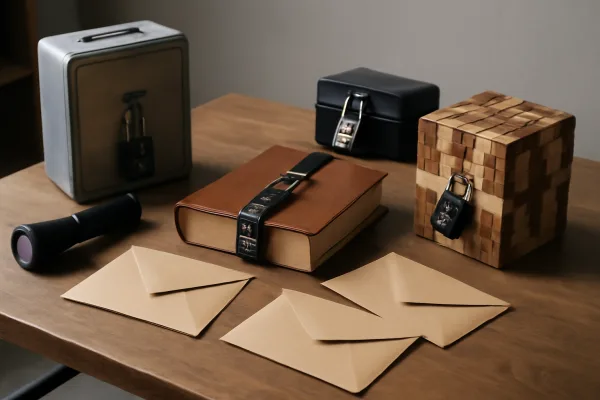
- Combination locks (1 to 3) — the cornerstone of physical escape room interaction
- Lockboxes or containers — small padlock boxes, toolboxes, or even lunch boxes that lock
- A countdown timer — use a phone or tablet with a large display countdown app
- Envelopes with wax seals (optional but atmospheric) — for delivering printed clues
- A UV flashlight — for invisible ink reveals
- Printed materials — maps, letters, newspaper clippings, photographs, coded messages
Budget prop ideas by theme:
| Theme | Key Props | Approximate Cost | Where to Find |
|---|---|---|---|
| Detective’s Office | Magnifying glass, fake case files, cork board with string, old books | $10-20 | Dollar store, thrift shop, printables |
| Haunted Room | LED candles, cobweb fabric, skeleton hand, fog machine | $15-30 | Dollar store, Halloween clearance |
| Secret Agent | Fake passports, sunglasses, briefcase, walkie-talkies | $10-25 | Dollar store, thrift shop, toy store |
| Treasure Hunt | Treasure chest (cardboard or plastic), gold coins, old map | $10-15 | Party store, Amazon, printable map |
| Science Lab | Beakers (from dollar store), colored water, lab coats, safety goggles | $15-25 | Dollar store, thrift shop |
Lighting is your most powerful tool. Changing the lighting in a room transforms its atmosphere more effectively than any other single change. Replace bright overhead lights with dim lamps, LED candles, or string lights. For a spooky theme, use colored LED bulbs (red or green). For a detective theme, a single desk lamp creates dramatic shadows. For a treasure hunt, scatter battery-operated tea lights to simulate lanterns. A twenty-dollar investment in lighting creates more atmosphere than a hundred-dollar investment in physical props.
Step 5: Set the Rules and Run the Experience
Before players enter the room, establish clear rules and expectations. This prevents confusion, ensures safety, and sets the tone for a smooth experience.
Essential rules to communicate:
- Time limit: “You have 60 minutes to escape. I will give you a 30-minute warning, a 15-minute warning, and a 5-minute warning.”
- Boundaries: “Everything you need is in this room. You do not need to leave the room, access the internet, or move any furniture.”
- Hint system: “You can ask for up to 3 hints. Raise your hand and I will provide a nudge in the right direction without giving away the answer.”
- Fragile items: “Please do not force open any locks or containers. If something does not open easily, you may not have the right combination yet.”
- Safety: “If anyone needs to leave the room for any reason, that is completely fine. The door is not actually locked.”
Running the experience as Game Master: Your role during the escape room is to observe, track progress, and provide hints when needed. Stay in the room or monitor via a baby monitor or video call. Track which puzzles have been solved and which are still open. If players are stuck on a puzzle for more than 10 minutes, offer a gentle hint. The best Game Masters provide hints that redirect attention rather than reveal answers: “Have you looked at everything on the desk?” is better than “The code is hidden under the desk lamp.”
Step 6: Scale Difficulty for Different Groups
One of the best things about a home escape room is the ability to adjust difficulty in real time. Here is how to calibrate the challenge for different audiences: Learn more at BoardGameGeek.
For children (ages 8-12): Use 4 to 5 simple puzzles with a 45-minute time limit. Focus on physical puzzles (finding hidden objects, assembling jigsaws, following a treasure map), simple codes (A=1 cipher), and lots of visual clues. Provide generous hints and celebrate every solved puzzle enthusiastically. The goal is excitement and accomplishment, not challenge.
For casual adults: Use 5 to 7 mixed-difficulty puzzles with a 60-minute time limit. Include a mix of easy early puzzles to build confidence and harder later puzzles that require teamwork. Offer 3 hints. Most casual groups escape with 5 to 15 minutes remaining, which is the ideal window: challenging enough to feel earned, not so hard that it becomes frustrating.
For experienced escape room enthusiasts: Use 7 to 10 puzzles with complex multi-step elements and a 60-minute time limit. Include red herrings (items in the room that look like clues but are not), require cross-referencing between multiple information sources, and offer only 1 to 2 hints. Experienced players expect to be challenged and appreciate puzzles that make them work for the solution.
10 Ready-to-Use Puzzle Ideas You Can Build Tonight
If you want to get started immediately, here are 10 specific puzzle implementations that require minimal materials and can be set up in under an hour:
- Puzzle 1: Write “LOOK UNDER THE RUG” in lemon juice on paper. Leave a heat source (hair dryer or lamp) as a clue. Under the rug, place an envelope with the next clue.
- Puzzle 2: Put a 3-digit combination lock on a box. Hide the three digits in separate locations: one on the back of a picture frame, one inside a book (on a bookmarked page), one under a mug.
- Puzzle 3: Print a crossword puzzle where the answers spell out a word when read vertically. The word is the key to the next puzzle.
- Puzzle 4: Create a map with an X marking the spot. The X corresponds to a real location in the room (a specific drawer, a corner behind a plant, inside a coat pocket in the closet).
- Puzzle 5: Write a message using the first letter of each line: an acrostic poem where the first letters spell the combination to the next lock.
- Puzzle 6: Place a mirror on the wall and write a backward message on a card. Players must realize to use the mirror to read it.
- Puzzle 7: Create a “torn letter” by writing a message and cutting it into irregular pieces. Scatter pieces in different envelopes around the room.
- Puzzle 8: Use a blacklight to reveal a hidden message written in UV marker on a seemingly blank piece of paper among other papers.
- Puzzle 9: Create a directional puzzle: “From the window, take 3 steps north, 2 steps east, look up.” The final clue is taped to the ceiling above that spot.
- Puzzle 10: The final puzzle: all previous solutions combine to form the code for the last lock. For example, if previous puzzles yielded the numbers 7, 2, 4, and 9, the final combination is 7249.
Conclusion
Creating a DIY escape room at home is one of the most rewarding entertainment projects you can undertake. It combines creative design, craftsmanship, storytelling, and hosting into an experience that your guests will remember long after the timer runs out. The six steps in this guide, choosing a theme, designing the puzzle flow, creating puzzles, building props, running the experience, and scaling difficulty, give you everything you need to create your first escape room tonight.
Start simple. Your first escape room does not need to rival a professional facility. Five clever puzzles, some atmospheric lighting, and a compelling story are enough to create an experience that will have your players begging for a sequel. And with each escape room you create, your design skills, puzzle repertoire, and hosting confidence will grow. Before you know it, you will be the person everyone asks to host the next game night.
Found this helpful? Share it with your puzzle-loving friends. We also have a great resource on murder mystery party that you might find helpful.
Frequently Asked Questions
How much does it cost to create a home escape room?
A basic home escape room can be created for $10 to $30 using household items and printed materials. Combination locks ($5-8 each) are the main expense. More elaborate setups with UV lights, multiple locks, and themed props typically cost $30 to $75. Compared to the $25-35 per person cost of a commercial escape room, home versions offer exceptional value.
How long should a home escape room last?
45 to 60 minutes is the ideal duration for most groups. Shorter experiences (30 minutes) work well for children or as part of a larger event. Longer experiences (75-90 minutes) are appropriate for experienced groups tackling complex puzzle sets. Always include a countdown timer so players can track their remaining time.
How many players is ideal for a home escape room?
2 to 6 players is the sweet spot for home escape rooms. With 2 to 3 players, every person is constantly engaged. With 4 to 6, there is enough variety for players to split up and work on different puzzles simultaneously. More than 6 players often results in some people standing around with nothing to do. If you have a larger group, consider running two simultaneous escape rooms in different rooms.
What if my players cannot solve a puzzle?
This is where the hint system comes in. As Game Master, you should monitor progress and offer hints proactively if a group is stuck for more than 10 minutes on a single puzzle. Start with a vague hint and get more specific if they remain stuck. Having a printable hint sheet prepared in advance for each puzzle makes this process smooth and consistent.
Can I reuse my home escape room for different groups?
Absolutely. This is one of the biggest advantages of home escape rooms over commercial ones. Once you have designed and built the puzzles, you can reset the room in 15 to 20 minutes and run it for a completely new group. Many hosts create one escape room and run it for 3 to 5 different groups over several weeks, making the initial time investment extremely cost-effective on a per-person basis.
The most rewarding aspect of creating home escape rooms is watching the transformation in your players. People who arrive skeptical leave as enthusiastic fans. People who consider themselves non-gamers discover a love for puzzles. And the shared experience of working together under pressure, celebrating breakthroughs, and ultimately escaping creates bonds that strengthen friendships and make your home the most popular gathering spot in your social circle. That transformation, from ordinary living room to extraordinary adventure, is what makes home escape rooms one of the most satisfying entertainment projects you can undertake.