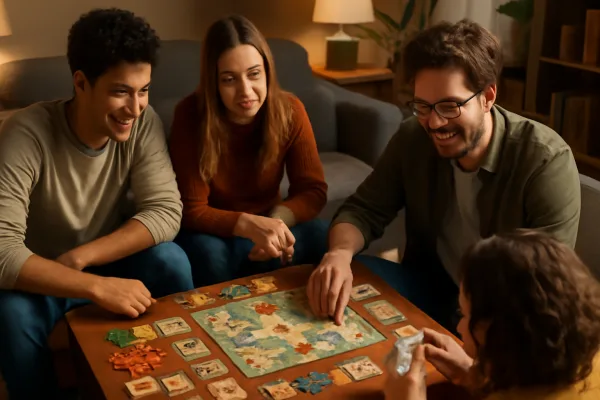
Blood on the Clocktower has taken the social deduction world by storm, becoming one of the most talked-about party games since its successful Kickstarter campaign raised over $1.3 million in 2022. If you have been hearing about this game and wondering whether it lives up to the hype, this comprehensive guide covers everything you need to know before buying, from how the game works and what makes it different from other social deduction games, to practical tips for running your first game night.
Unlike simpler social deduction games like Werewolf or Mafia, Blood on the Clocktower introduces a revolutionary Storyteller mechanic that keeps every player engaged throughout the entire game, even after they have been eliminated. With over 100 unique character roles spread across three difficulty scripts (Trouble Brewing, Sects and Violets, and Bad Moon Rising), the game offers a depth of strategic play that rewards repeated sessions while remaining accessible to newcomers.
Whether you are a seasoned social deduction veteran or someone who has never played a hidden role game before, this guide will give you everything you need to understand, purchase, and enjoy Blood on the Clocktower with your friends and family.
What Is Blood on the Clocktower and How Does It Work?
Blood on the Clocktower is a social deduction game for 5 to 20 players designed by Steven Medway and published by The Pandemonium Institute. At its core, the game follows a familiar premise: a group of Townsfolk must identify and eliminate an evil Demon who is secretly killing them one by one. However, Blood on the Clocktower adds several layers of innovation that set it apart from every other game in the genre.
The game is played over alternating Day and Night phases. During the Night phase, the Storyteller privately wakes certain characters to perform their abilities, such as the Demon choosing a victim, the Empath learning alignment information, or the Monk protecting a player. During the Day phase, all players discuss, debate, accuse, and ultimately vote to execute one player. The game continues until either the Town executes the Demon (Town wins) or the Demon is the last evil player standing with only two other players alive (Evil wins).
What makes Blood on the Clocktower genuinely revolutionary in the social deduction space is a collection of design decisions that solve problems that have plagued games like Werewolf and Mafia for decades:
| Common Problem | How Werewolf/Mafia Handles It | How Blood on the Clocktower Solves It |
|---|---|---|
| Player elimination is boring | Eliminated players sit out for the rest of the game (sometimes 30+ minutes) | Dead players become “ghosts” who can still talk, whisper, and use one final vote, staying engaged until the end |
| Games feel random with few players | With 5-7 players, there is not enough information to make meaningful deductions | The Storyteller can manipulate information to ensure every game has interesting decisions, even at low player counts |
| Experienced players dominate | Veterans easily read newer players, creating an uneven experience | The Storyteller can use the Drunk or Poisoner mechanics to give false information to experienced players, leveling the field |
| The same strategies repeat | Optimal play is often “solved” in simpler games | Over 100 unique roles across three scripts mean every game presents a different puzzle |
| Setup is complicated | Moderators must memorize rules and manage complex night phases | A dedicated app and clear Storyteller guide simplify setup and management |
The Three Scripts: Choosing Your Difficulty Level
Blood on the Clocktower organizes its character roles into three official scripts, each designed for a different experience level. Understanding these scripts is essential for choosing the right starting point for your group.
Trouble Brewing (Beginner) is the recommended starting script for groups new to the game. It features straightforward character abilities that are easy to understand and verify. Townsfolk roles include the Washerwoman (learns that one of two players is a specific Townsfolk role), the Librarian (learns that one of two players is a specific Outsider role), and the Empath (learns how many of their living neighbors are evil). The Demon in Trouble Brewing is the Imp, whose kill mechanic is simple and predictable. Most groups can learn and play a complete Trouble Brewing game in 60 to 90 minutes.
Sects and Violets (Intermediate) introduces madness, information manipulation, and more complex strategic decisions. The Demon is the Fang Gu, which can jump to a new player when it would otherwise die, creating unexpected twists. Townsfolk roles become more interactive, with characters like the Savant (who receives two statements from the Storyteller, one true and one false) and the Dreamer (who chooses a player each night and learns their character or an incorrect character). This script is ideal for groups that have played Trouble Brewing several times and are ready for more complexity.
Bad Moon Rising (Advanced) is the most challenging script, emphasizing player survival over information gathering. The Demon is the Zombuul, which appears to die when executed but secretly remains alive, creating paranoia about whether the Town has actually succeeded. Characters like the Gambler (who guesses another player’s character, dying if wrong) and the Gossip (who makes a public statement, causing a death if the statement is true) create high-stakes decisions that can backfire spectacularly. This script is recommended only for experienced groups comfortable with all core mechanics. You might also enjoy our guide on best social deduction games.
“Blood on the Clocktower is what happens when someone looks at Werewolf and asks, ‘What if we fixed everything that has been wrong with this genre for the last 30 years?’ The result is the best social deduction game ever made.” — Shut Up and Sit Down, board game review channel with over 1 million YouTube subscribers
How Many Players Do You Need?
Blood on the Clocktower officially supports 5 to 20 players, plus one Storyteller. However, the experience varies significantly depending on the player count, and understanding these differences will help you plan the best possible game night.
| Player Count | Experience | Game Length | Recommended For |
|---|---|---|---|
| 5-6 players | Intimate, fast-paced, less information to work with | 30-45 minutes | Quick game nights, learning the basics |
| 7-9 players | Sweet spot for most groups — enough information for deduction without overwhelming complexity | 45-75 minutes | Regular game nights, experienced and mixed groups |
| 10-12 players | Rich and dynamic — multiple information sources, complex alliances, intense debates | 75-120 minutes | Dedicated game nights, parties |
| 13-15 players | Epic and chaotic — many factions, deep strategic play, memorable moments | 90-150 minutes | Special events, conventions |
| 16-20 players | Massive and unpredictable — requires an experienced Storyteller | 120-180+ minutes | Conventions, dedicated events, experienced groups only |
For your first game, aim for 7 to 10 players. This range provides enough characters for interesting deduction while keeping the game manageable for a first-time Storyteller. If you have fewer than 7 players, the game still works but may feel less dynamic. If you have more than 12, consider having an experienced Storyteller or splitting into two simultaneous games.
What You Need to Play: Components and Setup
The official Blood on the Clocktower box set includes everything you need to play, but its premium price point (approximately $99 to $130 depending on the retailer) means some groups prefer to start with a more affordable option before committing to the full purchase.
The official box set includes:
- Character tokens for all three scripts (over 100 unique roles)
- A cloth Grimoire (the Storyteller’s hidden board for tracking night actions)
- Night order reminder tokens
- Voting tokens and shroud tokens (for marking dead players)
- A Storyteller reference guide for each script
- Fabric bags for token storage
Free and budget alternatives:
- The official online tool (clocktower.online): A free web-based version that allows you to play online or use a device as a digital Grimoire for in-person games. This is the recommended starting point for groups that want to try the game before buying.
- Print-and-play: The game’s character information is freely available, and community members have created printable token sets. You need only a way to display character tokens and a method for the Storyteller to track night actions.
- The mobile app: A companion app helps Storytellers manage night phases, track character abilities, and generate setup configurations. Available for iOS and Android.
Regardless of which components you use, you will also need a physical space large enough for all players to sit in a circle or semi-circle, with room for the Storyteller to move around. A living room, large dining table, or outdoor patio works well. You will also need a timer or clock for managing Day phase discussions (typically 5 to 15 minutes per Day phase, depending on player count).
Tips for First-Time Storytellers
The Storyteller role in Blood on the Clocktower is fundamentally different from the Moderator role in Werewolf or Mafia. In those games, the Moderator is a neutral facilitator who mechanically processes night actions. In Blood on the Clocktower, the Storyteller is an active participant who makes decisions that shape the game experience for all players. This is both the game’s greatest strength and its steepest learning curve.
Here are practical tips for running your first game as Storyteller: For additional reading, visit Blood on the Clocktower on BoardGameGeek.
Start with Trouble Brewing. The beginner script is specifically designed for new Storytellers. The character abilities are straightforward, the night order is manageable, and the amount of information manipulation required is minimal compared to the more advanced scripts.
Read the Storyteller guide thoroughly before game night. The official Storyteller guide for each script walks through every character ability, common edge cases, and strategic considerations. A 30-minute investment in reading this guide will prevent 90% of the confusion and mistakes that new Storytellers encounter.
Use the companion app for night management. The app displays the night order, reminds you which characters to wake and what information to give them, and tracks which characters are in play. This dramatically reduces the cognitive load on the Storyteller and prevents mistakes.
Do not try to make the game “fair.” This is the most common mistake new Storytellers make. Your job is not to ensure that the good team or the evil team wins. Your job is to create the most interesting and engaging game possible. Sometimes that means giving the good team a critical piece of information. Other times it means protecting the evil team from an early discovery. The goal is drama, tension, and memorable moments, not balance.
Embrace mistakes. You will make mistakes in your first several games. You will forget to wake a character, give incorrect information, or misinterpret an ability. This is normal and expected. The beauty of Blood on the Clocktower is that even Storyteller mistakes can be incorporated into the narrative. The community has a saying: “If the Storyteller made a mistake, it was probably the Drunk’s fault.”
Blood on the Clocktower vs Other Social Deduction Games
If you are already familiar with other social deduction games, understanding how Blood on the Clocktower compares will help you decide whether it is the right fit for your group.
| Feature | Werewolf/Mafia | Among Us | Secret Hitler | Blood on the Clocktower |
|---|---|---|---|---|
| Players | 6-20+ | 4-15 | 5-10 | 5-20 |
| Game length | 20-60 min | 10-20 min | 30-60 min | 45-150 min |
| Player elimination | Permanent, boring | Ghosts do limited tasks | No elimination | Ghosts stay engaged, get final vote |
| Unique roles | 5-10 typical | 0 (crew vs impostor) | 5 (Liberal, Fascist, Hitler) | 100+ across scripts |
| Replayability | Medium | Medium | High | Very High |
| Storyteller needed? | Yes (Moderator) | No (digital) | No | Yes (active role) |
| Learning curve | Low | Very Low | Low-Medium | Medium-High |
| Best for | Quick party games | Casual online play | Political intrigue fans | Dedicated game groups |
Blood on the Clocktower is not a replacement for simpler social deduction games. It occupies a different space in your game collection. If you want a quick 15-minute game to play between other activities, Among Us or Werewolf is a better choice. If you want a deep, immersive experience that becomes the centerpiece of a dedicated game night, Blood on the Clocktower is unmatched. Many groups find that discovering Blood on the Clocktower does not make them stop playing other social deduction games — it makes them appreciate the full spectrum of the genre. For more on this topic, check out our article about Werewolf game night.
Where to Buy and How Much It Costs
The official Blood on the Clocktower box set is available from several sources, with prices varying by retailer and availability:
- The Pandemonium Institute website: The publisher’s official store typically prices the game at $99 to $120 USD, often with exclusive promotional items or early access to new content
- Amazon: Available through various sellers, typically priced at $110 to $140 USD. Check seller ratings carefully, as counterfeit editions have been reported
- Local game stores: Many independent game stores carry Blood on the Clocktower at competitive prices, and buying local supports your community’s gaming ecosystem
- Board Game Geek Marketplace: Used copies occasionally appear at reduced prices, though the game’s popularity means used copies often sell close to retail
If the price point is a concern, remember that the game includes enough content for hundreds of unique game sessions across three difficulty levels. On a per-play basis, Blood on the Clocktower offers exceptional value compared to many board games. Additionally, the free online version at clocktower.online allows you to play indefinitely at no cost, making it easy to try before you buy.
Building Your Blood on the Clocktower Community
One of the best aspects of Blood on the Clocktower is the vibrant, welcoming community that has grown around it. Connecting with this community can enhance your experience significantly, providing access to experienced Storytellers, custom scripts, strategy discussions, and organized play events.
Online communities: The Blood on the Clocktower subreddit (r/BloodOnTheClocktower) has over 30,000 members sharing strategies, stories, and advice. The official Discord server hosts thousands of active players organizing online and in-person games. Board Game Geek has an active forum with detailed rule discussions and strategy analysis.
In-person events: Many cities have regular Blood on the Clocktower game nights at local board game cafes, bars, and community centers. Check Meetup.com, Facebook Groups, and your local game store’s event calendar for organized play near you. Conventions like Gen Con, PAX Unplugged, and Dice Tower Con typically feature Blood on the Clocktower events and tournaments.
Custom scripts: Once your group has mastered the three official scripts, the community has created hundreds of custom scripts using the game’s character database. These fan-made scripts offer new combinations of roles, unique mechanics, and fresh challenges that extend the game’s already impressive replayability. The official script tool allows you to browse, create, and share custom scripts with the community.
Conclusion
Blood on the Clocktower represents the pinnacle of social deduction game design. Its innovative Storyteller mechanic, ghost voting system, and vast library of unique character roles solve the fundamental problems that have limited the genre for decades. Whether you are a social deduction veteran looking for the ultimate experience or a curious newcomer drawn in by the enthusiasm of its community, Blood on the Clocktower delivers a gaming experience that is truly unlike anything else. Learn more at social deduction games.
Start with the free online version at clocktower.online to learn the basics. Gather 7 to 10 friends for your first in-person game using the Trouble Brewing script. And prepare yourself for the moment when a player you trusted reveals they were the Demon all along — because that moment is what Blood on the Clocktower is all about.
Found this helpful? Share it with your game night crew.
Frequently Asked Questions
Is Blood on the Clocktower appropriate for children?
The game is recommended for ages 15 and up due to its themes of deception, accusation, and elimination. However, many families play with younger teens using the Trouble Brewing script. The game does not contain graphic content — the “killing” is entirely abstract and narrative-driven.
Can you play Blood on the Clocktower online?
Yes. The official online tool at clocktower.online supports full online play with video chat integration. Many community Discord servers also organize regular online games. Online play is an excellent way to learn the game before hosting in person.
How long does it take to learn Blood on the Clocktower?
Most players can learn the basic rules in about 10 minutes. Understanding the specific character roles for a single script takes another 15 to 20 minutes. After one or two games, most players feel comfortable with the core mechanics. Mastering advanced strategies and Storyteller techniques takes many more sessions.
Do I need to be a good liar to enjoy Blood on the Clocktower?
Not at all. While deception is a core element, the game rewards many different skills including logical deduction, information analysis, alliance building, and strategic voting. Many successful players rely more on careful analysis than on lying ability. The game is enjoyable regardless of your comfort level with deception.
What is the best player count for Blood on the Clocktower?
Most experienced players consider 8 to 12 players the sweet spot, providing enough roles for complex deduction while keeping the game manageable. However, the game works well at any count within its 5 to 20 range. Smaller games are faster and more intimate, while larger games are more chaotic and dramatic. We also have a great resource on game night planning that you might find helpful.
Advanced Strategies for Experienced Players
Once you have played several games of Blood on the Clocktower, strategic depth begins to reveal itself. The game rewards not just logical deduction but also meta-gaming, information management, and social manipulation at a level that keeps experienced players engaged for hundreds of sessions.
Information economy: In Blood on the Clocktower, information is currency. Good players learn to manage what information they share, when they share it, and with whom. Revealing your role too early gives the evil team a target. Revealing it too late means the good team cannot benefit from your information. The optimal timing depends on your specific role, the current game state, and the players around you. As a general rule, Townsfolk with strong information (like the Empath or Washerwoman) should share relatively early, while roles with weaker or ambiguous information may benefit from holding back.
The whisper game: Blood on the Clocktower encourages private conversations (whispers) between players during the Day phase. Skilled players use whispers strategically: sharing private information with trusted allies, feeding misinformation to suspected evil players, or creating the appearance of alliances that do not actually exist. The evil team often uses whispers to coordinate their lies and establish cover stories. Learning to use and interpret whispers is one of the most important advanced skills in the game.
Voting strategy: Voting in Blood on the Clocktower is more nuanced than simply voting for the player you think is evil. Strategic voters consider questions like: Is it better to execute a confirmed good player to test a Demon theory? Should dead players use their precious final vote now or save it for a more critical moment? Can we use the threat of execution to force a player to reveal information? These voting decisions often determine the outcome of the game more than the deduction itself.
Reading the Storyteller: Experienced players learn to read the Storyteller’s body language, timing, and pattern of information distribution. A Storyteller who spends extra time during the Night phase may be managing a complex character interaction. A Storyteller who seems particularly engaged during a certain player’s claim may be noting a discrepancy. While the best Storytellers maintain a poker face, subtle cues inevitably emerge, and learning to read them is a legitimate (if controversial) advanced strategy.
Evil team coordination: Playing on the evil team is widely considered the most challenging and rewarding aspect of Blood on the Clocktower. Evil players must create believable cover stories, support each other’s claims without being too obvious, and navigate the information landscape without contradicting known truths. The best evil teams develop signals and strategies for communicating during the Day phase without tipping off the good team, often through carefully worded public statements that carry hidden meanings.
These advanced strategies represent just a fraction of the depth that Blood on the Clocktower offers. The game’s community has produced thousands of pages of strategic analysis, and new insights continue to emerge as players discover novel interactions between characters and scripts. This endless strategic depth is what makes Blood on the Clocktower not just a game, but a hobby unto itself.